

Bill Thrall on Shame, Trust, and the Pastoral Identity Crisis

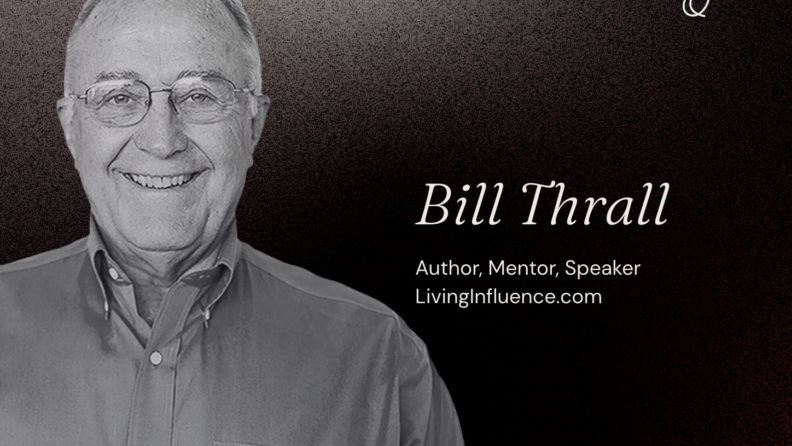
On Trust and Love: The degree to which I trust you is the degree to which I can experience your love... even if your name is God.
On Hiddenness: If there isn't somebody who knows everything, I become a victim of whatever I'm hiding. It's never neutral.
On Community: What you do next is never as important as who you do next with.
Interview Summary
Bill Thrall pastored for twenty years before spending the last three decades as a leadership development practitioner, author, and teacher. He describes his life's work in a single phrase: steward of a message of grace.
That message, that grace always makes contact with reality even when a pastor's theology doesn't, runs through everything he writes, teaches, and discusses.
His podcast, Living Influence for Leaders, is launching at livinginfluence.com, and he is currently working on four book projects simultaneously, driven by the conviction that there may not be unlimited time to finish them.

I'll admit I was a little starstruck going into this conversation. Bill's work has shaped my own thinking and the community I'm part of in many, many ways. What I didn't fully expect was how personal it would get, or that I'd end up being the one at the table admitting out loud that I wasn't sure Jesus would be enough on the other side of full exposure. That moment is what this conversation is really about.
Many pastors are trapped in a theology that doesn’t touch their reality… and I can’t think of anything more exhausting than preaching something that doesn’t impact my life.


On Why Pastors Aren't Thriving (4:26)
I asked Bill what he sees as the biggest reason pastors aren't thriving, and he resisted landing on just one. He offered three, and they all share a common thread.
The first is a theology that doesn't touch reality: pastors preach a message they can't apply to their own lives, and the exhaustion of that gap is chronic. What's missing, he says, is grace, because grace always makes contact with reality.
The second cause is an identity question: "Who do you say you are? Is it the same as who God says you are?" A pastor whose theology still convinces him he is primarily a sinner will be defined by shame, not by the gospel.
The third is misaligned expectations, the relentless pressure of what boards, congregations, and the pastor himself demand, compounded by the reality that fifty percent of pastors don't see themselves as leaders at all, even as the role requires them to function as one.

On Convictions Over Opportunity (8:36)
Thrall draws a line between two forces that can guide a leader, convictions and opportunity, and he insists they are not interchangeable. Opportunity can seduce, he says. Circumstances can define. Leaders who don't have a settled understanding of their own convictions become reactive, victims of whatever is in front of them. The question isn't whether opportunity is present; it's whether a leader's convictions have the authority to evaluate it.
On the Significance of Person (11:24)
I raised something I see constantly in the church world: the pull toward tactical solutions. Find the approach that's working somewhere else, copy it, fix the board meeting, make things run more smoothly. Thrall didn't dismiss that impulse. He said something more pointed: it is simply easier to look for answers about how to do something than to face a truth that would change who you are.
His central question for leaders is this: what if the most important factor in your influence is the significance of your person?
He illustrated it through David and Goliath. When Saul's armor didn't fit, David didn't need an alternative strategy. He went out with what he had, in Thrall's words, "with who he was." That day David knew he couldn't die, because he'd already been anointed king, and God would be a liar if Goliath could take him out. The slingshot was incidental. The person wasn't. Every pastor chasing a model that worked for someone else is reaching for Saul's armor.
On Isolation and Trust (19:09)
A 1994 Barna study Thrall cites found that sixty-three percent of Christian leaders don't finish well, with the number one cause being isolation. He returns to that statistic not to alarm, but to define it precisely. Isolation, he says, is not being alone. It is choosing to trust no one with who you are. That distinction changes the diagnosis. The guarded pastor surrounded by people he keeps at arm's length is more isolated than a lonely pastor with one honest relationship.
The logic that follows is direct: when a leader decides he doesn't know who he can trust, he has, without recognizing it, made a second decision, not to be loved. "The day I choose to not trust is the day I choose to not be loved." And no one, including Jesus, has access to a person without their permission.
The day I choose not to trust, is the day I choose not to be loved.
On Hiddenness and Fear (26:30)
I asked what it practically means to get out of hiddenness, given that many pastors do have a breakfast group or a few colleagues. Thrall identified the specific fear that keeps those relationships shallow: the expectation of spiritual superiority. Pastors operate under an image, and anything hidden threatens that image, so the posture becomes "come, but don't get too close."
His response is direct: if there isn't at least one person who knows everything, a pastor becomes a victim of whatever he's hiding. It is never neutral. And the belief that he controls what he's hiding is itself evidence that control is already gone. If he were in control of it, he would stop.
On Shame and Sin Management (28:33)
I asked whether shame was the primary villain for pastors. Thrall confirmed it without hesitation. He traced it back to Genesis: when Adam sinned, he experienced shame for the first time, and his immediate response was to cover himself with fig leaves. The first act of sin management in human history. That pattern, covering, managing, hiding, is what so many leaders continue to practice.
His argument is built on Romans 8:1. Trying to deal with shame directly is a losing approach. Learning to live in the reality that there is no condemnation in Christ is what gradually loosens shame's grip. He asks the plainest version of the question: who is teaching leaders to live without condemnation? His answer: very few, because so many haven't worked it out in their own hiddenness.
On Trusting Jesus with Shame (31:45)
Thrall makes the distinction the whole conversation has been building toward. Evangelicals have learned to trust Jesus with their sin: he is Savior, we are forgiven, we're going to heaven. But trusting Jesus with your life is a different commitment. Trusting Jesus with your shame is different again.
I told him honestly where I was: I'm convinced Jesus can handle my shame, but I'm not sure other people can. And deeper than that, I'm not fully convinced Jesus would be enough on the other side of full exposure. Thrall didn't soften it. He said he has sat across from hundreds of Christian leaders who trusted Jesus as Savior but never trusted him with their lives. The doubt is common. His response wasn't a theological argument. It was a practice: short prayers, prayed often. "Jesus, teach me to trust you with my shame."
On Permission, Humility, and Grace (35:07)
Thrall closed with a set of connected ideas. No one, including Jesus, has access to a person without their permission. He reads the Laodicean church passage not as an evangelistic image but as a word to the church: Jesus knocking at the door, not to condemn, but to invite. The church was convinced it had everything it needed. Jesus disagreed. He knocked anyway and waited.
I’m convinced that if King David was a pastor today, every other pastor in the world would purchase a slingshot.
He tied this to 1 Peter 5: God gives grace to the humble. His working definition of humility is concrete: "Humility is trusting God and others with me." It is not a disposition or an attitude. It is an act. And whenever a leader is able to do it, grace follows. The connection between humility and grace, in his framing, is not abstract. Trust is the door, and grace is what comes through it.

