

The best donor management software helps us as church leaders develop stronger relationships, increase recurring gifts, and prevent folks from falling through the cracks.
I've been involved in church leadership for over 20 years - and at one church I served, the finance team started using donor management software to track new givers and automate follow-up. Very quickly, they uncovered a surprising pattern—dozens of one-time givers had never received a thank-you or next-step communication. Once we implemented donor segmentation and scheduled touchpoints, the team re-engaged several high-capacity donors and saw a measurable bump in recurring giving.
Since those days, I’ve reviewed dozens of donor management tools—and in the right context, they’re indispensable. See, many churches are still working off spreadsheets, generic thank-you emails, and memory. That system might work when you're small—but it’s not scalable, and it’s not personal.
Donor management software changes the game. It helps you care for the people God’s already entrusted to your church. This list is here to help you find a tool that makes donor relationships sustainable, effective, and pastoral.
Why Trust Our Software Recommendations
6,700+
Reviews
20
Industry experts
16+
Evaluation factors
14
Years
Our team has been testing and reviewing software since 2012. As church leaders ourselves, we know how difficult—and important—it is to choose the right software.
For this guide, we evaluated tools using hands-on testing and independent research, scoring tools using our selection criteria.
Our reviews reflect our human editorial judgment, not a sales pitch.
Donor Management Software for Churches Comparison Table
The table below compares pricing details for my top donor management software selections for churches.
| Tool | Best For | Trial Info | Price | ||
|---|---|---|---|---|---|
| 1 | Best for recurring donation management | Free plan available | From $150/month | Website | |
| 2 | Best for all-in-one church management | Free plan available + 30-day free trial | From $12/month | Website | |
| 3 | Best for secure donation tracking | 30-day free trial | From $19/month (billed annually) | Website | |
| 4 | Best for zero-fee nonprofit fundraising | Free plan available | Free to use | Website | |
| 5 | Best for donor retention | Free demo available | From $40/month (billed annually) | Website | |
| 6 | Best for individual donor profiles | 30-day free trial available | From $72/month | Website | |
| 7 | Best for simplifying processes | 30-day free trial | From $45/month (billed annually) | Website | |
| 8 | Best for donor relationship building | Free demo available | From $33/month | Website | |
| 9 | Best for integrated church management | Not available | Pricing upon request | Website | |
| 10 | Best for diverse donation methods | Free trial available | From $69.99/month | Website |


The Best Donor Management Software Reviews
Here’s a brief description of each of the donor management software on my list, showing what it does best, plus screenshots to showcase some of the features.
 Best for recurring donation management
- Free plan available
- From $150/month
Visit WebsiteCustomer Rating:4.8/5
Donorbox offers a mail center feature for managing donor communications. Donorbox is a church fundraising platform built to help you manage donations, engage donors, and grow your fundraising through flexible giving options. You can create branded, customizable donation forms, accept one-time and recurring gifts online, through mobile, via text-to-give, or in person using the Donorbox Live Kiosk. Each contribution links to donor profiles for easy tracking, helping you manage relationships and giving history over time. Additional tools like donor portals, event ticketing, and peer-to-peer fundraising help diversify your fundraising efforts, making it easier to boost engagement and maintain steady support for your church’s mission.
Pros and Cons
Pros:
- Ability to accept in-person payments via mobile devices
- Supports multiple fundraising methods, including ticketing and auctions
- Customizable donation forms to suit various needs
Cons:
- Lack of advanced reporting features
- Transaction fees can add up for smaller organizations
Learn more about Donorbox: Best for all-in-one church management
- Free plan available + 30-day free trial
- From $12/month
Visit WebsiteCustomer Rating:4.9/5
ChMeetings has a centralized dashboard with a quick overview of church activities, including contributions, attendance, events, and follow-up tasks. ChMeetings is a cloud-based Church Management Software (ChMS) that helps churches in the US, Canada, UK, Australia, and South Africa simplify administration and donor management. Used by over 7,000 churches across these regions, it offers member and group management, attendance tracking, and secure online donations, making it easy to organize congregational records and track contributions. With built-in financial tools for budgeting and reporting, plus a multilingual interface supporting 22 languages, ChMeetings ensures smoother church operations. It also provides a standard mobile app for convenient access, with an option to upgrade to a branded version. A free plan for up to 50 members makes it an accessible choice for smaller congregations.
Learn more about ChMeetings: Best for secure donation tracking
- 30-day free trial
- From $19/month (billed annually)
Visit WebsiteCustomer Rating:4.8/5
Gracely's dashboard gives you a quick overview of church members and recent donations. Gracely is an all-in-one platform built to help you manage members, track donations, and run events for your church or organization. One of the main reasons I chose Gracely is its secure online giving and contributions tracking. You can create multiple funds (like building, missions, or campaigns), accept one-time and recurring donations both online and in person, and embed giving widgets on your site. It links each gift to individual donor profiles so you and your team can stay on top of who's giving and when. You can also archive old funds and categorize donations as tax-deductible or not—great for clean reporting and transparency.
Learn more about Gracely: Best for zero-fee nonprofit fundraising
- Free plan available
- Free to use
Visit WebsiteCustomer Rating:4.9/5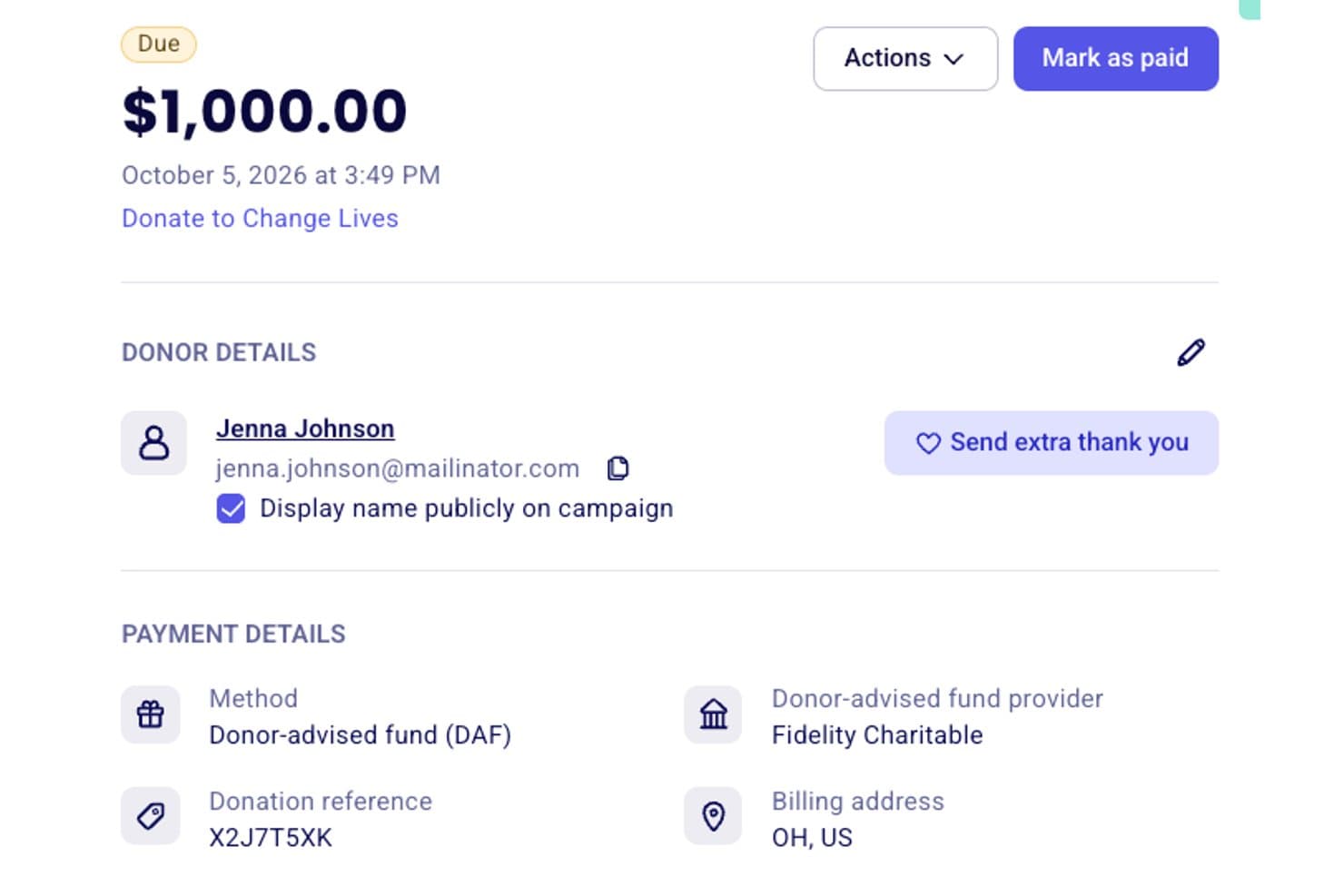
Zeffy displays donor details and DAF payment info for each donation. Zeffy is an all-in-one nonprofit fundraising and donor management platform that combines donation forms, recurring giving, pledge tracking, event ticketing, donor segmentation, and email outreach in a single system.
Who Is Zeffy Best For?
Zeffy is a strong fit for small and mid-sized nonprofits, including churches and faith-based organizations, that need a full fundraising and donor management toolkit without platform or transaction fees.
Why I Picked Zeffy
Zeffy is one of my top picks because I love that it eliminates platform and transaction fees entirely, which is a real differentiator for small and mid-sized ministries watching every dollar. I'm particularly impressed by how it consolidates donor profiles, recurring giving, pledge tracking, and event ticketing into one place, so your team isn't jumping between systems. The built-in donor segmentation lets you filter by giving frequency, campaign, or lapsed status and save those lists to update automatically as contacts change.
Zeffy Key Features
- Automatic tax receipt generation: Zeffy issues and emails tax receipts to donors immediately after a successful payment when automatic receipts are enabled.
- Donor Mail printed appeals: Create personalized letters that Zeffy prints, stuffs, and mails for $1 per letter, with QR codes and delivery tracking built in.
- Household and company grouping: Link related contacts into households or company records and view their combined giving history in a single profile.
- QuickBooks Online integration: Sync future payouts to QuickBooks as deposits mapped to income accounts by campaign or fund.
Zeffy Integrations
Zeffy documents 1,000+ connections, including native QuickBooks, WordPress, and Mailchimp integrations. It also offers a public API, webhooks, viaSocket, and Zapier for custom connectivity.
Pros and Cons
Pros:
- Tracks online, recurring, and offline gifts
- Saves dynamic donor segments for targeted outreach
- Combines donor, event, and giving histories
Cons:
- Pledge tracking lacks installment schedules and donor reminders
- Checkout prompts can confuse donors
Learn more about Zeffy: Best for donor retention
- Free demo available
- From $40/month (billed annually)
Visit WebsiteCustomer Rating:4.7/5
Bloomerang offers a donation dashboard as well as CRM features such as logging calls with donors. Bloomerang focuses on retention and engagement solutions. It allows fund transactions and management to be carried out efficiently and on time.
Pros and Cons
Pros:
- It is affordable for all sizes of startups and non-profits
- Great customer support
- Great user interface
Cons:
- QuickBooks integration isn't smooth
- Report customization is limited
- Difficult to use when tracking grants from foundations
Learn more about Bloomerang: Best for individual donor profiles
- 30-day free trial available
- From $72/month
Visit WebsiteCustomer Rating:4.7/5
Tithe.ly provides detailed member profiles for managing contact details, family connections, and engagement history. Tithe.ly is an all-in-one platform designed to help churches manage donations, engage members, and organize events. Its digital giving tools support online, mobile, text, and in-person contributions, with options for recurring donations and campaign-specific giving pages. Each donation links to individual donor profiles for accurate tracking and reporting, while communication tools help churches keep donors informed and engaged. Additional features include peer-to-peer fundraising, event management, eCommerce capabilities, and integrations with platforms like QuickBooks, Salesforce, and Planning Center, making Tithe.ly a strong choice for churches looking to streamline giving and donor management in one place.
 Best for simplifying processes
- 30-day free trial
- From $45/month (billed annually)
Visit WebsiteCustomer Rating:4.7/5
Easily search for donors and constituents, track volunteering hours, and measure fundraising totals. Little Green Light describes itself as “your natural next step to simplify your donor management.” It promises, “With our intuitive fundraising platform, you can consolidate your spreadsheets, letting you see and analyze your data more clearly than ever before.”
Pros and Cons
Pros:
- Mail and online support
- Seamless integration with third-party software
- Intuitive and easy-to-use interface
Cons:
- Advanced analytics are complicated
- Difficult to manage families
- Mobile support is lacking
Learn more about Little Green Light: Best for donor relationship building
- Free demo available
- From $33/month
Visit WebsiteCustomer Rating:4.4/5
Kindful keeps track of recent transactions and donations from donors. Kindful is donor management software that focuses on building relationships with donors. It offers fundraising, donor management, and communication tools. The software also comes with tracking and reporting tools.
Pros and Cons
Pros:
- Supports unlimited donation pages per account with numerous page designs and customization
- Scalable and focuses on helping non-profits grow
- Excellent and timely customer service
Cons:
- Report design options are limited and lack customization
- Pricey for small non-profits with inconsistent income
- Takes a while to learn and get around
Learn more about Kindful: Best for integrated church management
- Not available
- Pricing upon request
Visit WebsiteCustomer Rating:4.1/5
Realm offers reports on key metrics to provide insights for church management. Realm by ACS Technologies is a cloud-based church management software platform that offers integrated tools and services for ministries, administration, and pastoral care.
I chose Realm as the donor management software after evaluating its comprehensive features tailored for churches and religious organizations. It provides a suite of tools for communication, stewardship, and pastoral care, all accessible through a user-friendly interface and convenient mobile apps, which are essential for modern church management.
Pros and Cons
Pros:
- Streamlines communication with members.
- Customizable forms and pages.
- Organizes member database efficiently.
Cons:
- Limited integration with other CRM systems.
- May require training to fully utilize all features.
 Best for diverse donation methods
- Free trial available
- From $69.99/month
Visit WebsiteCustomer Rating:4.8/5
SteepleMate lets you track financial transactions, including donations, expenses, and transfers. SteepleMate serves as an effective donor management software tailored for churches, incorporating features that facilitate financial and donation management. It supports various donation methods such as online donations, QR code giving, and text giving, providing convenience for both donors and administrators. The software includes pledge management and fundraising campaign tracking, allowing churches to efficiently monitor donations and interact with their congregation. Additionally, secure donor data encryption ensures the safety of sensitive information. Features like recurring donations, offering management, and detailed contribution reporting further assist in simplifying financial tasks, while integration with QuickBooks ensures accurate and transparent accounting.
Learn more about SteepleMate:
Other Donor Management Software Options
- 11BlackbaudBest for data and analytics
- 12AplosBest software for church accounting
- 13DonorPerfectBest for donor segmentation and communication
- 14Salesforce for NonprofitsBest for large scale non-profits
- 15Salsa LabsBest software for advocacy and event management
- 16Church Community BuilderBest for building supporter community
- 17Servant KeeperBest for systems and processes
- 18Donor ToolsBest volunteer and donor management software
- 19ChurchTracBest for tracking congregational giving and funds
- 20SubsplashBest for donation tracking and analytics
- 21MinistryPlatformBest for large churches
How I Evaluate Donor Management Software
I split my evaluation into two layers: baseline features every tool needs—like fund-designated giving and year-end statements—and the differentiators that set the best-fit tools apart.
Core Functionality (Table Stakes For This List)
When I'm selecting tools for my list, I rank each one on a scale from 0 (does not offer the functionality) to 5 (excels in this area) for each core functionality listed below. Then, I calculate the tool's total score into a percentage. Each tool needs to achieve a minimum total score of 55% to be considered for inclusion.
- Donor Profile Management: I check whether each tool ties giving history, household relationships, and engagement data into a single donor record rather than scattering it across disconnected lists.
- Online & Mobile Giving: Each platform should support recurring gifts, multiple payment methods, and mobile-friendly options like text-to-give so congregants can give during services or from home.
- Fund & Designation Tracking: I evaluate how each tool handles multiple funds—like building campaigns, missions, and benevolence—and whether it distinguishes restricted from unrestricted giving.
- Contribution Statements & Tax Receipts: Year-end statement generation matters, so I look at whether a tool can batch-send compliant giving summaries via email and print without heavy manual formatting.
- Pledge & Campaign Management: Stewardship drives need real tracking, so I look for tools that let you set campaign goals, monitor pledge fulfillment, and send reminders to donors who are behind.
- Giving Reports & Analytics: I evaluate whether the reporting goes beyond simple totals to offer donor segmentation, lapsed-giver identification, and trend views that help church leaders spot giving shifts early.
Once I have a list of tools that meet this criteria, I consider what sets each platform apart.
Differentiating Factors (What Sets Vendors Apart)
Here's how I compare and contrast different vendors:
Standout Features
Native ChMS integration matters a lot here. When giving data flows directly into your church management system—like Planning Center or Breeze—you avoid double entry and keep member records accurate. I also look for automated donor communications, like triggered thank-you emails after a first-time gift or re-engagement messages when a regular giver goes quiet. A donor self-service portal rounds things out by letting members update payment methods and pull their own statements, which saves your admin team hours during tax season.
Beyond Features
Payment processing fees deserve close attention because they directly affect how much of each gift reaches your church. I compare transaction rates on credit cards and ACH giving and check whether donors can opt to cover fees at checkout. Implementation support also matters—migrating years of giving data from a legacy system like ACS or PowerChurch can go sideways fast without dedicated migration help. Finally, I consider whether the vendor's support team understands church-specific workflows like fiscal year-end giving pushes and capital campaign timelines.
How to Choose Donor Management Software
This is a big decision.
After all, the right donor management software will save your team time and headaches.
The wrong one? It’ll collect dust while you go back to spreadsheets.
So before you sign up for anything, here’s what you actually need to think through:
1. Will Your Team Actually Use It?
If the software feels like flying a 747, your team will bail. So look for something simple. It should feel natural to use - no tech degree required.
2. Does It Play Nice With the Tools You Already Use?
You shouldn’t have to copy and paste data between systems like it’s 1998.
Good software integrates with your accounting, email, and other platforms.
If it doesn’t? Skip it. You’ll just create more work for yourself.
3. Can It Grow With You?
You’re not planning to shrink your ministry, right? So, make sure your donor management software can scale as you grow. You don’t want to outgrow your system in a year and start this whole process over again.
4. Will the Software Tell You What You Actually Need to Know?
You don’t need complicated spreadsheets. You need clear reports—the kind that actually help you spot trends, track engagement, and answer questions from your board without sweating.
5. Will You Get Real Support When You Need It?
Even simple tools come with a learning curve. To that end, make sure the company offers real support—not just a chatbot or a generic FAQ page. You’ll want live help and training when (not if) you hit a wall.
The Bottom Line?
Pick a tool that works today and grows with you tomorrow. One that makes life easier—not harder. One your whole team can actually use.
You’ve got people to lead. Don't get stuck managing tech that doesn’t pull its weight.
Trends in Donor Management Software
In 2026, donor management software is moving fast. The pressure to do more with fewer hands isn’t going away, and the latest tools are rising to meet that reality.
Here are the top trends shaping where things are headed:
1. Automation and AI Integration
Automated Donor Engagement
More platforms now offer workflows that trigger personalized emails or follow-up tasks based on donor behavior. A first-time gift triggers a thank-you. A six-month gap triggers a reminder to reconnect. These automations strengthen relationships without adding to your workload.
AI-Powered Analytics
Artificial intelligence is now scanning giving patterns and surfacing recommendations. Best time to reach out. Best method to use. No digging through reports—just smarter decisions, faster.
2. Mobile-First Design
Enhanced Mobile Access
Dashboards are now built for phones, not just desktops. You can check donations, update records, or message a donor from the parking lot or the pulpit. This shift makes sense for leaders who live on the move.
3. Data Security and Compliance
Stronger Data Protection
Security isn’t optional. Today’s platforms are encrypting donor data, offering secure login features, and following regulations like GDPR. That protects your people and your church.
4. Customization and Flexibility
Tailored Reporting Tools
Churches don’t all run the same. More tools now offer customizable reports so you can track what matters to your leadership team, not just what’s standard.
This isn’t just about keeping up with tech—it’s about using the right tools to lead more effectively in a digital world.
What Is Donor Management Software?
Donor management software helps churches and nonprofits track donations and build relationships. It keeps names, contact info, and giving history organized in one secure place. With great donor management software in place, you can:
- See giving history at a glance
- Send personalized thank-you emails
- Run reports for leadership or tax statements
No more spreadsheets. No more paper files. Just a clear, streamlined system that frees you up for actual ministry.
Features of Donor Management Software
When selecting donor management software, keep an eye out for the following key features:
Contact management: Store and organize detailed records for every donor, including their donation history, personal information, and communication preferences. This makes it easier for you to stay connected and personalize your outreach.
Donation tracking: Keep tabs on every contribution, whether it’s one-time, recurring, or event-based. Accurate donation tracking helps you analyze trends and acknowledge gifts quickly.
Event management: Plan, promote, and manage fundraising events directly within the software. With this feature, you can handle RSVPs, ticket sales, and post-event follow-ups all in one place.
Reporting and analytics: Generate detailed reports on donations, donor engagement, and campaign results. These insights empower you to spot opportunities, track progress, and share impact with stakeholders.
Campaign management: Organize and monitor fundraising campaigns from start to finish. You get to set goals, automate reminders, and measure campaign performance effortlessly.
Automated acknowledgments: Set up thank-you letters or emails that go out automatically every time someone donates. Not only does this save you time, but it also helps build loyal relationships.
Integration capabilities: Connect with other tools like email marketing platforms, accounting software, or CRM systems to streamline your workflow and reduce manual data entry.
User access controls: Assign different levels of access to team members, so everyone has the right tools without compromising donor data privacy.
Common Donor Management Software AI Features
Beyond the standard donor management software features listed above, many of these solutions are incorporating AI with features like:
Predictive donor analytics: Use AI to analyze giving patterns and predict which donors are most likely to give again or increase their support. This helps you focus your efforts where they can make the biggest impact.
Automated donor segmentation: AI can sort your donor list into segments—like first-time givers or high-potential supporters—so you can tailor communications and appeals more effectively.
Personalized communication recommendations: Let AI suggest the best messages or timing for reaching out to different donors, increasing the chances they’ll respond positively.
Smart donation forecasting: AI tools can forecast future donation trends based on previous campaigns and current engagement, helping you plan your fundraising strategies with more confidence.
Intelligent donor scoring: Allow AI to rank your donors by engagement, affinity, or giving potential, so you always know who to cultivate for your next big campaign.
Benefits of Donor Management Software
When the right system is in place, everything gets simpler. Here’s what it makes possible:
1. Automated Donor Tracking
No more manual updates or spreadsheet errors. The system keeps everything accurate so you can focus on real conversations—not record-keeping.
2. Centralized Data
All your donor info—gifts, communication, involvement—lives in one place. Nothing scattered, nothing lost.
3. Better Reporting
Spot giving trends. Track engagement. Share clear updates with your board without a two-hour spreadsheet session.
4. Streamlined Communication
Send thank-yous and updates in minutes. Engage supporters consistently without reinventing the wheel each time.
5. Recurring Donation Management
Keep giving steady without constant reminders. Less chasing. More stability.
When systems run smoothly, ministry gets more margin. That’s what this is about.
Costs & Pricing for Donor Management Software
Donor management software comes with different pricing options to fit various church budgets and needs. If you’re new to this, know that each plan includes different levels of features—the more advanced the tools, the higher the cost. Here’s a quick breakdown of the most common plan types, what they cost, and the features you can expect at each level.
| Plan Type | Average Price | Common Features | Best For... |
|---|---|---|---|
| Plan TypeFree Plan | Average Price$0/month | Common FeaturesBasic donor tracking, limited reporting, email support | Best For...Small organizations or startups |
| Plan TypeBasic Plan | Average Price$30/month | Common FeaturesDonor profiles, automated emails, simple reporting | Best For...Growing churches, basic needs |
| Plan TypeStandard Plan | Average Price$70/month | Common FeaturesCustom reports, event management, recurring donation tracking | Best For...Medium-sized churches, more advanced needs |
| Plan TypePremium Plan | Average Price$150/month | Common FeaturesAdvanced integrations, detailed analytics, priority support | Best For...Large organizations, full features |
| Plan TypeEnterprise Plan | Average Price$300+/month | Common FeaturesFully customizable features, dedicated account manager, unlimited users | Best For...Large nonprofits or organizations with complex needs |
When choosing a plan, think about your church’s size, budget, and the tools you need to manage donor relationships well. If you're just starting out, a free or basic plan can help you get set up. As your needs grow, you can upgrade to access more advanced features.
Donor Management Software Frequently Asked Questions
How do I avoid paying for features my church doesn’t need?
Start by listing the specific tasks your church needs help with—like tracking donations or sending thank-you emails. When shopping for software, look for plans that let you pick only what you’ll use. Many companies offer modular pricing, so you don’t have to pay for extras. Always ask for a detailed price breakdown before signing up.
Are there any hidden costs I should watch out for with donor management software?
Watch for extra charges like setup fees, data migration costs, or added fees for more users or advanced features. Some platforms charge for support or upgrades. Before deciding, ask the vendor for a full list of possible charges and read the contract carefully so there are no surprises.
Can I use donor management software with volunteers or part-time staff without paying for extra licenses?
Some tools let you add volunteers or part-timers as limited users at no extra cost, but others charge per user. Ask about user limits and roles before choosing a platform. If you need more access for helpers, look for software that offers free or discounted seats for volunteers.
Is there a way for small churches to get donor management software for free or at a big discount?
Yes, several companies offer free plans with basic features or special discounts for small churches and nonprofits. Search for nonprofit donor management software or reach out directly to vendors to ask about deals. Some providers will even work with you to customize a plan that fits your budget.
What happens if our church needs to switch to a different software later on?
If you need to change software, make sure you can easily export your data—donor lists, giving history, and reports. Ask about cancellation policies and data portability before signing up. Planning ahead makes it easier to move your records without extra costs or headaches.