

The Loneliness Fix Most Pastors Are Getting Wrong (feat. John Lynch)

Image management vs vulnerability: Image management inoculates you against love: "If they knew the real me, they wouldn't think that."
Peer groups can be an escape hatch: When pastors only practice vulnerability outside their church, they tell their members "true community belongs elsewhere."
The room of Grace: What if there was a place where the WORST of you could be known, and you'd be loved more, not less?
I've talked to enough pastors to know that most of them have a 'group'... usually a handful of other church leaders, often guys from other churches, other cities, or other denominations. Their group 'gets it'... It's a safe place to vent, to be understood.
"Find a group like that" is extremely common advice for pastors today. However, the counsel from pastor, speaker, and author John Lynch cuts across that grain.
When pastors only choose to be vulnerable other pastors, they're telling their congregation: you're not safe for me. I can't trust you.
Lynch knows what he's talking about. He spent nearly four decades as the preaching pastor at Open Door Fellowship in Phoenix, AZ, and authored several best-selling books ("The Cure" and "On My Worst Day".) He's toured with multi-platinum and gold-certified band MercyMe, and spoken at countless churches all over North America.

And there's a clear thread through the observations he shared with me.
65% of Pastors Report Feeling Isolated
This is according to research from Barna Group. Lynch isn't surprised by that number. But he thinks the "find a group outside your church" solution only reinforces the root problem.
"I hang out with a group of leaders," he says, "who get on because it's safe in our group. They don't know how to be themselves in their own communities. And so when they come out to our group, they let loose like eighth-grade kids just snapping towels."
These aren't men who lack relational capacity. They're men who have trained themselves not to use it in the places that matter most.
The core problem is often structural.
Pastors learn early that there's a certain level of vulnerability permitted in their role, and they model that level for everyone around them.

The loneliness at the top doesn't stay at the top. It becomes the culture. Your church community senses your hesitancy and concluces "I'm not allowed to be vulnerable around here."

'Finding Peer Group' Is Not A Healthy Solution
As you've no doubt heard, the standard prescription for pastoral loneliness is a cohort of peers. Pastors from other churches, ideally. People who understand the pressure and have no stake in your success or failure. While John Lynch understands the need, he's got a valid concern.
What you do," he says, "is create a culture that says vulnerability will only happen out there. I'm not going to get to know you. I'm not going to trust you.
When the pastor only builds trusting relationships with people outside his church, he sends a clear signal:
- "I don't trust you."
- "Vulnerability is for the professionals."
- "You only get the 'managed' version of me."
And that gap, between pastor and people, doesn't just leave the pastor lonely. It produces a congregation that's relationally shallow because they've been shown what the permission level is.
You (Likely) Didn't Choose to Put On A Mask
Lynch doesn't moralize about the mask. He understands it as a default in church leadership cultures:
There is a whole model of leadership," he says. "Hey, I'm the answer man. Type A, and I'm on my game. It's a style.
Lynch puts it plainly: "If I've been wearing a mask consistently, what people think they see is not me. And eventually, I can't hold up the act. I have to keep moving on, because they're on to me. And it's miserable."
So sure, the mask WORKS, in a way... but be warned. When you've been wearing a mask long enough, you lose access to the love people are actually trying to give you.
Someone tells you you're a great pastor, and somewhere underneath the gratitude is a quiet voice: if you knew the real me, you wouldn't say that.
Image Management, or Vulnerability?
In our conversation, John Lynch shared a framework for the Christian life that many of his listeners and readers have found super helpful. He calls it "The Two Rooms" (the room of good intentions, and the room of grace).

In the room of good intentions, the goal is to manage your image well enough that people continue to trust you. You perform, hide, and move on when someone starts suspecting you.
The room of grace starts with a different question:
What if there was a place SO safe you could reveal the worst of yourself, and discover that you're loved more, not less in the telling of it?
In the room of grace, the person across from you carries the same Jesus you do. At their deepest level, they have a new heart that can be trusted. So when you look at them, you're not looking at an adversary, or an audience. You're looking at someone worth knowing.
Building that room of grace in your church or leadership team is messy, difficult, and feels risky. When a leadership team chooses to do that together, though? When they decide to commit to one another, to stay long enough, trust enough, RISK enough?
An intangible sense of safety and community begins to grow, and the congregation can feel it.
People walking in the door for the first time can feel it - often with the first 5-6 minutes of being in your church. They don't always know what they're feeling. But they feel something different. And they want to come back.
Someone Has To Be First On The Beach
Most pastors wait for the environment to change before they do. They wait for the elders to get safer. Waiting for the staff culture to shift. Waiting for someone else to go first so the risk feels smaller.
The real work starts with a decision to risk being known by someone inside your own community who isn't a pastor.

Everything else is play acting. This is the Gospel. For us to love each other and be loved by each other.
This is the direct answer to the peer group problem we raised earlier. When you reserve your real self for other pastors, you've already told your congregation where the trust boundaries lie. Going first means crossing it, even before it feels safe.
Friendships you don't see coming...
Lynch talks about friendships in his own community that still catch him off guard. People he'd never have found if he'd kept his vulnerability reserved for ministry peers. "I go, how did we become friends? What in the world? You're a goofball." But those are some of his deepest friendships. People who know his weaknesses and have decided that's not a deal breaker.
CAUTION: Discretion Required
There's a difference between appropriate discretion and hiding. Vulnerability doesn't mean telling everyone everything. After all, not many people have EARNED that place in your inner world.
"Let me be hurt many times," he says, "if I can have just two or three real relationships where I am known and loved - and I get to know and love. That is worth everything."
That's the trade he's making. Being known inside the mess, by people who see the weakness and decide: that's not a deal-breaker. Has John gotten hurt? Will YOU get hurt? Of course... real relationships come with that risk.
But I've also been protected, affirmed, and carried by people who know the worst of me. And I'll take that trade every time.
If You Want This, But Don't Have It:
John Lynch doesn't overspiritualize that scenario, and his advice is candid.
Find a place that's teaching this. Seek it out. There are communities of grace, books about grace, and wonderful ministries that can support you. You don't have to reinvent the wheel. You just have to want it badly enough to find it.
"There's a way of life worth risking for," Lynch says, "that is not transactional. It doesn't require you to guard your heart or put on airs. You might think the Body of Christ needs a perfect priest, but they don't. They need the real Christ in you, pastor."
One Person Is Enough to Start
The reality of church structure creates tension for many pastors. The people most capable of offering genuine community to pastors are also often the people it feels most dangerous to be honest with.
A lot of pastors have been burned by trusting the wrong person in that dynamic.
You don't need to bare your soul to the whole board. You only need one person to start with.
You've got to find one person you can be truly yourself with, so that you're not hidden. Start there. Find one person you can be TRULY yourself with, so that you're not hidden. Start slowly... perhaps forward this article to them, and see what they do with it.
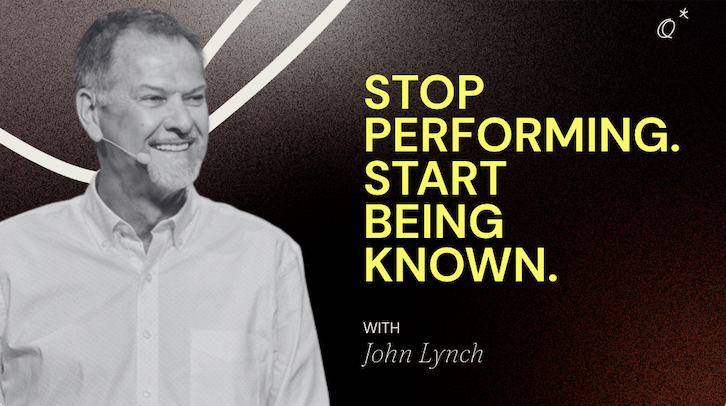
Environments of grace are not built with programming. It starts with individuals choosing, at cost, to stop performing and start being known.
Does this resonate?
Join our free membership for thought-provoking insights from seasoned pastors like John Lynch. We'd love to have you!
John Lynch is the author of The Cure and On My Worst Day, and the founder of John Lynch Speaks. You can reach him at john@johnlynchspeaks.com.

