


Key Takeaways
Give AI a Role, Not a Task: Framing AI as a brainstorming partner rather than a content generator changes the quality of everything it produces.
Input Determines Output: The more theological context, personal perspective, and specific detail you bring to the conversation, the more useful AI becomes.
YOU’RE the Driver: AI will run ahead of you if you let it. The pastor's job is to lead the conversation, not follow where the tool takes it.
Trust, But Verify: AI hallucinates. It will fabricate scripture, statistics, and case law with complete confidence. Cross-reference anything that matters.
Don't Replace People: AI is phone-a-friend, not your worship team. It helps you get unstuck. It doesn't replace the humans in the room.
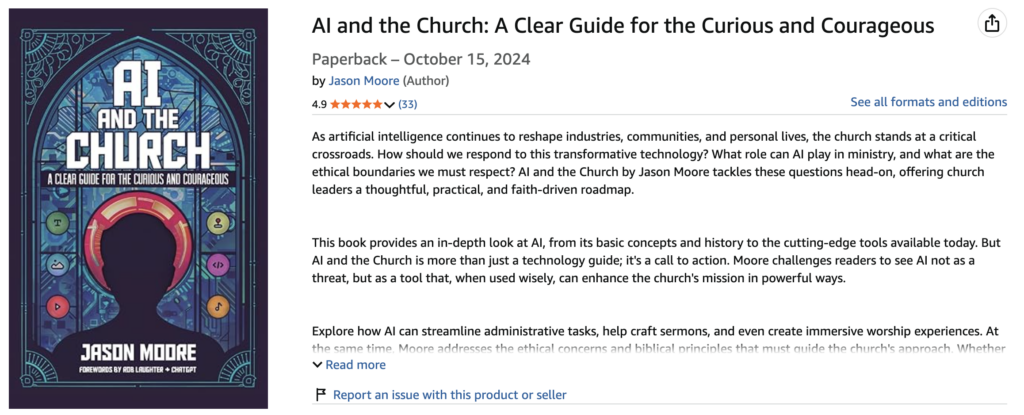
When generative AI arrived in 2022, Jason Moore started asking the same question he's been asking his whole career: “How can the church use this well?”
He’s been in ministry for nearly 30 years. After graduating from art school, he spent two decades convincing churches that live bands and screens in worship weren't the enemy. He wrote a book on hybrid worship during the pandemic.
Most Pastors Use AI Poorly.
In our conversation, Moore shared how most people open ChatGPT, and type a command. They hit enter, read what comes back, maybe tweak it a little, and move on.
Moore calls this treating AI as a command or a query. The outputs reflect it — generic, flat, disconnected from you, your church, your theological convictions, and the specific people sitting in your pews.
The shift he recommends is from command to conversation. Those aren't the same thing, and the difference shows up immediately in what you get back.
When you come to AI with context — here's what I'm planning, here's the Scripture I'm working from, here's my theological angle, here's what I already think I want to say — and then ask it to brainstorm with you rather than produce for you, the outputs change. You're not asking it to do the work. You're asking it to work alongside you.
The First Question in the Session Should Go to AI.
One of the most practical things Moore suggests is also one of the least obvious. Before you start asking AI your questions, ask it one first.

Have an account? Log In
"What do you need from me to be successful?"
Most people skip this entirely. They assume the tool knows what to do with whatever they give it. But when you ask that question, AI will respond with clarifying questions — how long is the series, who's the target audience, what text are you focusing on, what's the theological lens you're working from. Those questions aren't just useful for the AI. They're useful for you. They force you to articulate what you actually want before you've invested time going in the wrong direction.
If God can speak through a burning bush, a donkey, and a disembodied hand writing on a wall, He can speak through bits and bytes. Asking the Holy Spirit to guide the session is a reminder of Who's supposed to be in the driver's seat.
Give AI a Role Before Giving It A Task
There's a meaningful difference between "plan me a six-week series on the fruit of the Spirit" and "I'm working on a series on the fruit of the Spirit and I want you to play the role of brainstorming partner." The first invites it to generate. The second invites it to collaborate.
Pull it back when it runs ahead — and it will run ahead. If you've said you want to brainstorm and it starts laying out a full series outline with titles and scripture references, stop it. You're leading this conversation.
Context Is the Missing Ingredient
AI doesn't know you. It doesn't know your church, your preaching style, your congregation's history, or what you've already tried and rejected. Every piece of that information you withhold is a piece of yourself you're leaving out — and the outputs reflect the absence.
This means the conversation has to stay active. Keep giving it your perspective as things develop. Correct it when it misses your meaning. Tell it when a direction doesn't fit your context.
One application Moore finds particularly useful is what he calls collaborating with the cloud of witnesses.
Working on a series and want to understand how different theological traditions have handled a passage? Ask for the Wesleyan perspective. Then Calvin. Then Spurgeon. You're not getting those theologians — you're getting a trained model's representation of their positions, which means you still need to think critically about what comes back.
AI is phone-a-friend, not a replacement for your team.
Jason Moore
But you can cover theological ground in a single session that would otherwise take days, and that's a legitimate tool for series planning.
AI Will Confidently Fabricate Facts.
At a training he was leading, he walked a group through how AI could help plan a series — picking out songs, suggesting themes, generating outline options.
Someone in the room said: "Great. I don't need my team anymore."
Moore's response: you completely missed the point.
AI helps you get unstuck.
It can surface ideas, challenge your assumptions, fill in historical context, and push back on your premise in ways that sharpen your thinking. What it cannot do is replace the people in your building who know your congregation, have prayed over this series with you, and will be standing in the room when you preach it.
AI hallucinates.
There's also a reliability problem worth taking seriously. It is trained to produce an answer, and when it doesn't have a good one, it will sometimes manufacture one. Moore has seen AI fabricate scripture and invent statistics.
The best AI rule? Trust but verify — cross-reference anything that carries weight before you build on it.
Pray Before You Start the Session
Why is this valuable advice? Not because AI needs to be cleansed or sanctified… rather: YOUR posture matters.
If you open a chat session the same way you'd open a browser tab — quickly, casually, looking for something to make the task go faster — you've already decided what kind of conversation you're going to have.
More Articles
You have a soul. The tool does not.
Bring enough of yourself to the conversation — your convictions, your questions, your wrestling, your prayer — and you'll get something worth using.
Join a Community of Forward-Thinking Pastors
Don’t navigate the future of ministry technology alone. Get more insights like these, plus exclusive resources to help you lead well in the age of AI.
Join The Lead Pastor Membership for Free
We'd love to have you!