


Key Takeaways
Sermons and programs don’t make disciples; relationships do, one or two people at a time.
Measure discipleship by how many people in your church are actually making disciples.
Discipleship thrives in an atmosphere of grace where people can fail without hiding.
Ed, tell us a little about yourself, and specifically what Recentered does for pastors.
I started Recentered Group after pastoring Church of the Open Door for 21 years. I’ve been a pastor for 40 years. Before that I was an army officer, and before that I was a firefighter on a hotshot crew. I’ve always had it in my heart to help pastors. Pastors are lonely, and most churches don’t pay attention to the health of their leadership team.
We started Recentered to help churches get back to what matters most to Jesus: the two greats. The Great Commission is to make disciples of all nations. The Great Commandment is to love one another. Churches lose sight of both under the crushing weight of local church ministry and everything else that gets in the way.
So we help:
- wounded pastors get healthy
- help churches with leadership problems get healthy
- promote building discipleship cultures in churches.
How Ed Was Discipled
You often say discipleship happens in relationship. Who discipled you, and what do you remember most about how they did it?
I’m a Jesus Movement convert. I trusted Christ in the late ’60s and early ’70s, and the first person to disciple me was a man named Stan, through Young Life.
Back then, all we had was the King James Version. I was in college, and we met at College Life House, a Campus Crusade ministry (now Cru). Stan bought me a Scofield Reference Bible. I didn’t know anything about the Bible. While I was in class all day, he spent the whole day with a yellow marker, highlighting where the Scofield notes connected to the text.
We went through the Young Life discipleship materials, usually at a park. He’d pick me up and take me places. He was a friend before I even knew what discipleship was. He was just a friend telling me about Jesus, and I grew tremendously.

Have an account? Log In
Why Churches Lose Commitment to Discipleship
Fast forward to your years as a pastor. Was there a moment when you realized your church’s discipleship efforts weren’t producing disciples?
At Dallas Seminary, my life was marked by Howard Hendricks, who was huge on discipleship. Discipleship was all I had known: my Jesus Movement pastor discipled me, and in the army it was all about discipleship.
Then I pastored a church in the Midwest, a church in the Northwest, and finally Church of the Open Door. Not one of them had what I’d call relational discipleship, where you sit down with one person (if they’re a brand-new believer) or two or three people and equip them to live the Christian life. That’s what discipleship is: equipping and encouraging people to trust and follow Jesus.
Their view of discipleship was the pastor’s sermons and the programs. Nothing’s wrong with sermons. I preached for 40 years and I love it. But sermons aren’t really effective at equipping people to trust and follow Christ. So I had to start from scratch in every church.
At Church of the Open Door, it surprised me. It was a historic, deeply biblical church, but there was no discipleship. When I raised it, people said, “Well, we have the sermons, we do this, we do that.” One former elder really got it, and even though he no longer attended, he became my ally.
The materials I’d used before had shifted toward shame-and-guilt Christianity rather than grace and our identity in Christ, so I wrote a new course called Beginning in Grace, which I still use today. I took the elders through it and told them, “I’m going to ask you to take somebody else through.” It just began to grow.
The elders were hesitant at first. But once they discipled a young man, became his friend, and knew his life, it was like catching a virus. Once someone has been used by the Holy Spirit to make a big difference in somebody’s life, marriage, parenting, and church involvement, they’re never going back.
I’ve been in leadership at four different churches, and I see churches create a discipleship program, put someone in charge of it, and then the pastors move on to the budget or church growth. It’s almost like they’ve checked a box. Is that a fair observation?
It’s a disconnect. One problem is that the church has embraced corporate-style leadership, and that’s what corporate leadership does: somebody handles HR, somebody takes over this, somebody takes over that.
I challenge the pastors I work with at Recentered to change the culture by going first and by preaching the Great Commission. At Church of the Open Door, I preached the Great Commission the first Sunday of every year. People would say, “We’re kind of tired of this,” and I’d say, “Yes, but there are new people who don’t understand that this is most important.” The next week I’d preach on unity and loving one another, always in the context of relationships.
My wife, Judy, picked it up and started discipling women, and those women began discipling one another. We ended up with layered discipleship: junior highers doing basic discipleship in children’s ministry, high schoolers investing in junior highers, college students investing in high schoolers.
Seven years later, under a different pastor I love, Church of the Open Door still does discipleship. For the last two years, one of their “breakthrough prayers” has been for 75 new discipling relationships with non-Christians. They track it, and they’re past 50 now.
When I look back on my life, I’ve heard thousands of sermons and preached a couple thousand myself. But my most important memories are of being discipled by someone who loved me, cared for me, and listened to me, or of someone I was discipling having a breakthrough.
I’m famous for Ed’s First Rule of Theology: God is smart. If He tells us to make disciples, there must be something to it. The barrier is that discipleship is a slower way to grow than programs, and pastors are under a lot of pressure to bring in the numbers.
Making Time for Discipleship
Imagine a pastor who agrees with you but looks at a jam-packed calendar and wonders how to carve out time for a couple of discipleship relationships. What would you tell them?
Take the risk and trust the Lord Jesus, who gave you the command to make disciples.
At Church of the Open Door, I spent a lot of time with our leaders changing the culture because we were too busy. There was no room for discipleship, so we dropped a couple of things. In churches, change is a four-letter word, so it’s difficult.
It starts with putting it on your calendar. It happened to me just yesterday. I always have one guy I’m discipling who’s a joy to disciple, and he was waiting for me in Glendora at 10 o’clock. That morning I got about six calls from pastors and churches saying, “I need you.” All I said was, “Let me check my calendar. I’m sorry, that time’s taken.” People typically won’t ask what you’ll be doing.
Because discipleship was so new at Church of the Open Door, I had to get off campus and away from my office to do it. I’d meet a guy for breakfast or coffee, or have him in our home.
Jesus' Model of Discipleship
Your approach is built on how Jesus discipled. Talk about the pattern you see and how it shapes your philosophy.
I learned discipleship from Howard Hendricks, stole all his material, and have taught it at a Bible college and in seminars and churches ever since.
In the Gospels, Jesus began by simply doing His mission in front of the disciples: teaching, healing, all of it. Then He had them do it while He watched and corrected them. It was all relational. You can’t find a place where Jesus sat down and said, “Today we’re going to talk about the Trinity.” Teaching came up in real life, which is easier when you’re camping around Israel together.
Then, in Matthew 10, He sent them out two by two. So: He did it and they watched; they did it and He watched. After the Mount of Transfiguration, the disciples couldn’t cast the demon out of a boy, and Jesus used it as a teaching moment: “This kind only comes out by prayer and fasting.” When we send people out, they come back with real questions, and they learn from the answers.
Then we let them go. We trust them. They’ll make mistakes, and we’ll hear what they told somebody and wince, but they’re going to do it.
When I trained small group leaders, they called me “No-Show Ed.” I’d say, “I’ll lead your new group for a couple of weeks, then you lead it for a couple of weeks, and we’ll do an after-action report.” I’d give feedback, like telling someone, “You talk too much. Let the silence happen.” In small groups and in discipleship, whoever makes the next comment after a silence guides the discussion, so you want to stay quiet and let the other person speak.
Then I’d stop showing up. One leader you know well, Mark, answered when I called (this was before cell phones) and asked when I was coming. I said, “I’m not. Bye.” He did great. That’s what we have to do.
Right now I’m taking a man through Beginning in Grace. He’s from an ethnic community and works in show business, and we’re talking about how he’ll reach his community and translate this into it. I’ve asked him to pray about who he’ll disciple, and he already has someone in mind. He offered to order a copy of Beginning in Grace, and I said, “No, I’ll bring you one.” It’s worth it to me.
More Articles
Choosing and Empowering Disciples
For a pastor just starting out, how do you decide whom to invite into a discipleship relationship?
In about half the churches I’ve worked with, we began with the leaders. Sometimes the leaders aren’t interested. Then you start discipling someone else so you’ll have stories to tell. When leaders hear someone say, “We were on the verge of divorce, then Ed and Judy started discipling us, and now look at us,” they start thinking, “Wait a minute, that’s powerful.”
I always look for someone who’s eager and really wants it. It’s tricky for lead pastors because everyone wants the pastor to disciple them. Howard Hendricks said to look for FAT people:
- Faithful
- Available
- Teachable
I’d always say, “We’re going to do this for a season.” The word “season” gave me a parachute if someone wasn’t doing the work or kept missing meetings. I’ve eaten more breakfasts alone at 5 a.m. than I can count.
Discipleship, like all ministry, is messy. But the messiness is intimate.
Ed Underwood
You can say to someone, “You didn’t show up.” That will never happen with preaching.
In programmatic discipleship there’s built-in distance. If I don’t show up, I’m just one of the crowd. Is that right?
It’s true. The larger a small group becomes, the less commitment there is, because people figure nobody will notice if they’re absent.
Another thing we did at Church of the Open Door was write discipleship into every job description: every elder, staff member, small group leader, and children’s ministry worker. We weren’t legalistic about it. People go through busy seasons. But we wanted them to know that if we’re running programs without discipleship, we’re not doing what matters most to Jesus. Discipleship produces sustainable growth in a person’s life, and it takes time.
How do you know when someone is ready to disciple somebody else?
They never feel ready. While they’re being discipled, we want to make sure they’re healthy and don’t have an agenda. People sometimes come to churches with agendas, and you don’t want to hand others off to them. Healthy doesn’t mean they have everything together. But, for example, we’d be very careful with addicts. We typically wouldn’t let an addict disciple anyone but another addict, because a regular person will love them, and addicts often take advantage of that.
Usually people are more ready than they think, and we trust the power of the Holy Spirit. The real key is chapter three of Beginning in Grace: they need to know who they are in Christ and understand the constitutional change that happened inside them. We have two pages listing 35 changes that happen supernaturally the moment a person trusts in Christ. Most Christians have no idea. There’s no such thing as an insignificant Christian. If they know they have the Holy Spirit, a new nature, and power not to sin, they’re ready.
And we keep emphasizing grace, grace, grace. Sustainable change comes from trusting Jesus more, not from someone blowing the whistle because we ran out of bounds.
Inside Beginning in Grace
Let’s talk more about Beginning in Grace, which you’ve developed over years with hundreds of people.
Thousands have used the original version. It needed updating, so we recently released a revised and updated version, with a digital version as well.
The goal is to take someone from the street to baptism, exactly as they did in Acts.
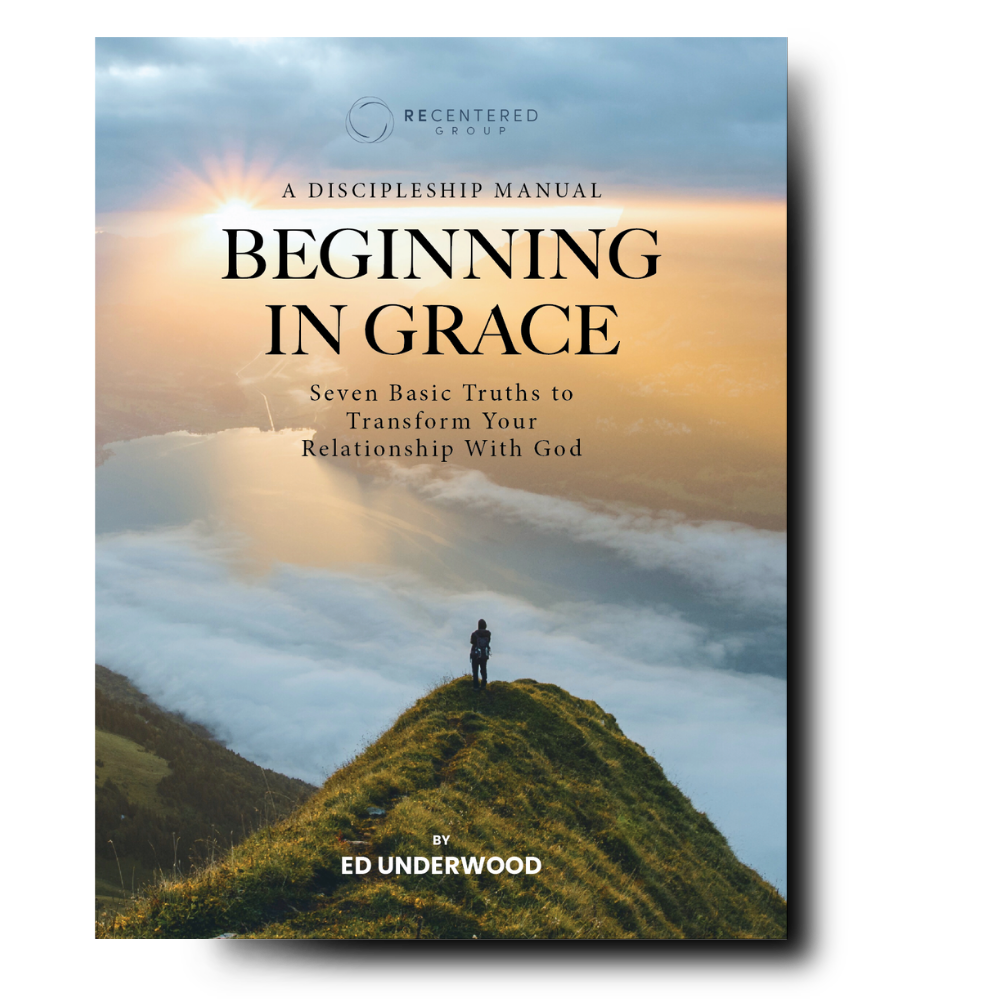
Here’s how Beginning in Grace is structured:
Beginning your relationship with God (chapter one).
How to have a relationship with God, understand His grace in your life, and grasp John 3:16: salvation is a transaction based only on faith. At Church of the Open Door, some people who had sat under J. Vernon McGee and attended every conference said, “This is so basic.” I’d say, “Give it a chance.” After working through it, they’d say, “It was so good for me to review this.”
Deepening your relationship with God (chapter two).
The power of prayer: you relate to God through prayer, and He relates to you through the Bible. Most Christians, even in conservative circles, know verses but don’t know how the Bible fits together, so we show them how the Old Testament is structured and how it connects to the New.
Your new identity in Christ (chapter three).
I added this because most Christians’ two favorite hymns are “Just As I Am” and “I’ll Fly Away.” What about the middle part? The middle is sanctification, Romans 5–8. This chapter centers on Galatians 2:20: your new identity, the power you have, and the blessings you have in the heavenly places.
The purpose of your relationship with God (chapter four).
Built on Ephesians 2:10. Pastors aren’t the only ones called; everyone is. One man I discipled runs a real estate business, and now 30 guys come to Bible studies in his office, working through Galatians and Colossians. He sees that as his Ephesians 2:10 purpose.
Relating to others in Christ (chapter five).
Church, marriage, and relationships, but from the perspective of grace and identity. It’s not “Husbands, love your wives or you’ll get in trouble.” It’s “Husbands, love your wives as Christ loved the church, and you know how He loves you.” We also go through Proverbs. I ask open-ended questions throughout. Yesterday a longtime Christian said, “Wow, Ed, you get right to it. These are personal.” I said, “Yes, because if it’s not changing my life, I’m just piling up knowledge.”
The Bible doesn’t say to put God's Word in notebooks. It says to hide it in your heart.
Ed Underwood
Sharing Jesus’ love with others (chapter six).
How to share the gospel. We spend a lot of time in Colossians 4:2–6. We have it upside down: we think sharing the gospel is talking about Jesus, but Paul shows it’s building relationships with non-Christians and being sensitive to them.
Your part in the body of Christ (chapter seven).
Here we’d ask, “Where would you like to serve at Church of the Open Door?” A brand-new Christian might start by listening to kids recite Bible verses in children’s ministry. One man, a football coach at Azusa Pacific with a theology degree, was ready to be an elder, so I challenged him to that. Others might become small group leaders.
This is where pastors need to understand their own job description. Read Ephesians 4. It isn’t preach sermons so more people come. It’s equip the saints for the work of ministry.
Ed Underwood
I love sermons and dedicated my life to preaching them accurately.
But in the Midwest church, I wrote small group notes that asked, “What was Ed’s main idea from Sunday?” By Wednesday, people couldn’t tell me. I only did that for about a month because it was so embarrassing.
Discipleship gets you into someone’s life. Yesterday, the man I met with told me three things coming up for him, and I put them on my calendar. He knows Ed and Judy will be praying for him next Tuesday. It’s intimate and effective.
Measuring Discipleship
When it comes to discipleship, pastors seem to have a choice to make. The best growth is often slow, oak-tree growth, rather than fast growth that may not last. If a pastor chooses the slow path, how do they measure it? Pastors can track giving, attendance, small groups, volunteers, and even website traffic. Relational discipleship is much harder to measure. How do we do that?
Primarily through stories and through invitations. But the main indicator is how many people in your church are actually making disciples.
How long it takes depends on the person. Taking someone through Beginning in Grace might take a year.
With the man I’m discipling now, who knows his Bible well, we’ll probably do a chapter a week. At Recentered, we’re also writing eight-week Bible studies on Galatians and Colossians, and there are other resources, because you want to stay in that person’s life as long as you can. We also try to hand people off to others, because I don’t have disciples. I’m making disciples of Christ.
Discipleship also gives you a real way to talk about giving, not “We’re in a church crisis and need money.” You can ask, “Tell me about your finances. Are you a giver?” Usually I don’t have to ask, because their finances are a mess. I’ll say, “The only thing I know about finances is that if you’re a steward, Jesus promises to take care of you. So let’s begin with giving.” And it’s sustainable, because they give from understanding, not pressure.
To wrap up, talk about Jesus-centered community and safe, truth-telling relationships as the bedrock of effective discipleship.
At Recentered, we talk about building an atmosphere of grace. We have to preach it and repeat it constantly. It’s a place where people know they can fail, because we all will, and they don’t have to hide it.
When I visit a church, I can tell within minutes of walking in whether it has an atmosphere of grace. People are talking, relating, and lingering. In an atmosphere of grace, people expect to be valued, listened to, and heard. They won’t be shamed when they mess up, but they will be corrected. We don’t say, “You had an affair, but that’s fine, we’re a grace church.” Grace is hard on those things, but in a way that says, “I love you. This is terrible. Let’s talk about it.”
Then we’re committed to building relationships of trust. When a church has an atmosphere of grace and relationships of trust, discipleship will thrive. I never know where I’ll begin with a church or a pastor. Sometimes we start with the atmosphere of grace, and sometimes with building trust among the leaders.