Cvent Review: Pros, Cons, Key Features and Updated Pricing


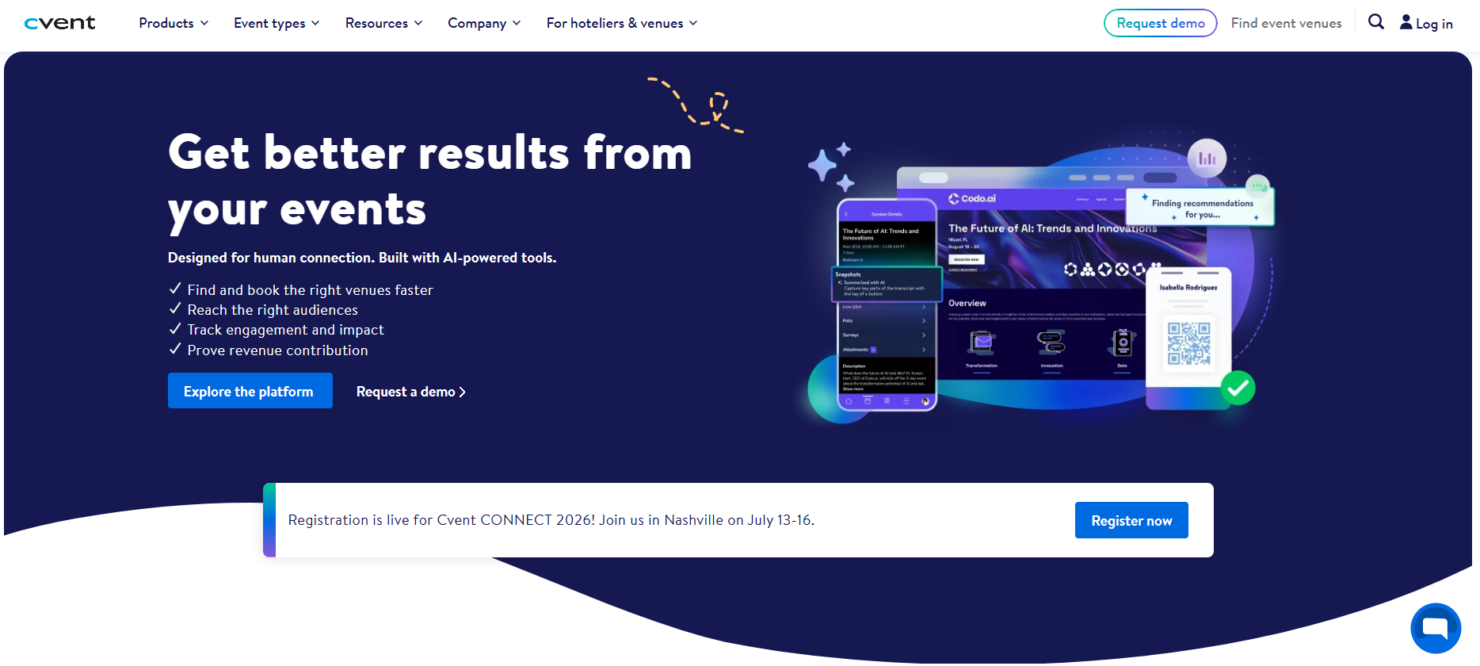
Cvent is a church attendance software built around event registration, check-in, and attendance tracking for churches running large-scale or multi-event ministry programs. I'd choose it if your church hosts conferences, multi-site gatherings, or ticketed events that need structured registration workflows and detailed attendance data. If you're comparing it to Planning Center, Cvent goes deeper on the event management side. It's a stronger fit for high-volume events where Planning Center's tools start to feel limited.
Cvent Evaluation Summary
- Pricing upon request
- Free demo available
Why Trust Our Software Recommendations
Our team has been testing and reviewing software since 2012. As church leaders ourselves, we know how difficult—and important—it is to choose the right software.
For this guide, we evaluated tools using hands-on testing and independent research, scoring tools using our selection criteria.
Our reviews reflect our human editorial judgment, not a sales pitch.
Cvent Overview
Cvent offers a wide range of event management features and strong reporting, making it a top choice for churches handling complex or large-scale events. Its pricing and learning curve can be higher than some alternatives, but the platform’s integrations, support, and customization options set it apart.
If you’re judging solutions for multi-session conferences or hybrid gatherings, Cvent’s interface and onboarding resources help teams get started, though smaller ministries may find it more than they need. When selecting a platform, consider Cvent if you value depth of functionality and reliable support over simplicity.
pros
-
Offers advanced attendee tracking and reporting tools
-
Supports complex, multi-session event structures
-
Provides strong customer support and training resources
cons
-
Pricing is higher than many similar event platforms
-
Some users report slow system performance during peak times
-
Custom branding options are limited without add-ons
-

AskMyChurch
Visit Website -
ChMeetings
Visit WebsiteThis rating combines scores from multiple user review sites to reflect overall customer sentiment about the product.4.9 -
Subsplash
Visit WebsiteThis rating combines scores from multiple user review sites to reflect overall customer sentiment about the product.4.5





How We Test & Score Tools
We’ve spent years building, refining, and improving our software testing and scoring system. The rubric is designed to capture the nuances of software selection and what makes a tool effective, focusing on critical aspects of the decision-making process.
Below, you can see exactly how our testing and scoring works across seven criteria. It allows us to provide an unbiased evaluation of the software based on core functionality, standout features, ease of use, onboarding, customer support, integrations, customer reviews, and value for money.
Core Functionality (25% of final scoring)
The starting point of our evaluation is always the core functionality of the tool. Does it have the basic features and functions that a user would expect to see? Are any of those core features locked to higher-tiered pricing plans? At its core, we expect a tool to stand up against the baseline capabilities of its competitors.
Standout Features (25% of final scoring)
Next, we evaluate uncommon standout features that go above and beyond the core functionality typically found in tools of its kind. A high score reflects specialized or unique features that make the product faster, more efficient, or offer additional value to the user.
We also evaluate how easy it is to integrate with other tools typically found in the tech stack to expand the functionality and utility of the software. Tools offering plentiful native integrations, 3rd party connections, and API access to build custom integrations score best.
Ease of Use (10% of final scoring)
We consider how quick and easy it is to execute the tasks defined in the core functionality using the tool. High scoring software is well designed, intuitive to use, offers mobile apps, provides templates, and makes relatively complex tasks seem simple.
Onboarding (10% of final scoring)
We know how important rapid team adoption is for a new platform, so we evaluate how easy it is to learn and use a tool with minimal training. We evaluate how quickly a team member can get set up and start using the tool with no experience. High scoring solutions indicate little or no support is required.
Customer Support (10% of final scoring)
We review how quick and easy it is to get unstuck and find help by phone, live chat, or knowledge base. Tools and companies that provide real-time support score best, while chatbots score worst.
Customer Reviews (10% of final scoring)
Beyond our own testing and evaluation, we consider the net promoter score from current and past customers. We review their likelihood, given the option, to choose the tool again for the core functionality. A high scoring software reflects a high net promoter score from current or past customers.
Value for Money (10% of final scoring)
Lastly, in consideration of all the other criteria, we review the average price of entry level plans against the core features and consider the value of the other evaluation criteria. Software that delivers more, for less, will score higher.
Core Features
Event Registration Management
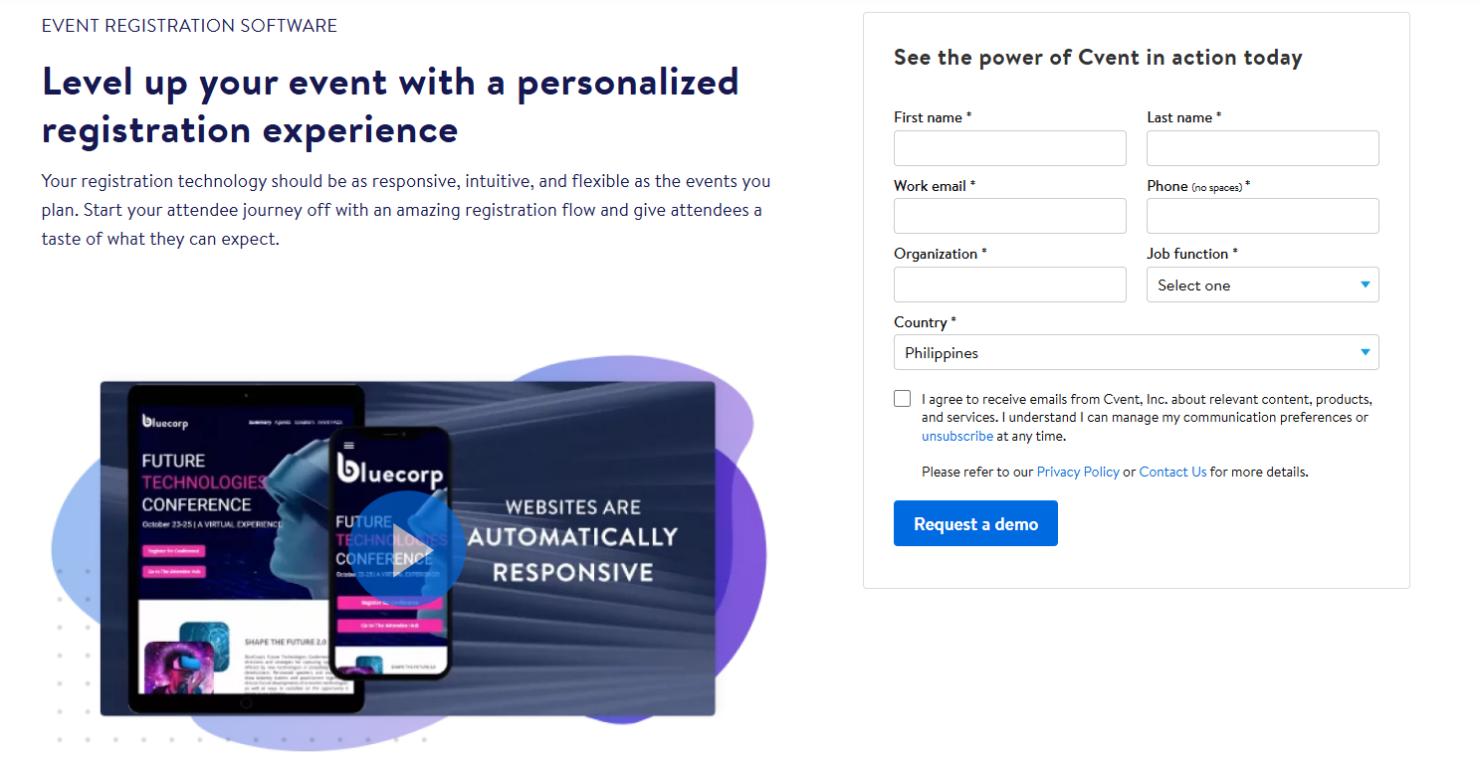
Create custom registration forms, manage attendee data, and automate confirmations. Users can set up tiered pricing, group registrations, and waitlists.
Attendee Tracking and Reporting
Monitor check-ins, session attendance, and engagement in real time. Generate detailed reports to analyze participation and event success.
Onsite Event Solutions
Use Cvent’s mobile app and badge printing for smooth onsite check-in. Kiosk and QR code support help reduce wait times and manual errors.
Session and Agenda Management
Build multi-track agendas, assign speakers, and manage session capacities. Attendees can personalize their schedules and receive updates.
Surveys and Feedback Collection
Send post-event surveys and collect attendee feedback and follow-ups directly through the platform. Analyze responses to improve future events.
Event Website Builder
Design branded event websites with drag-and-drop tools or with pre-made templates. Share event details, agendas, and registration links in one central place.
Ease of Use
Cvent offers a detailed interface with many options, which can feel overwhelming for new users or those managing simple events. However, its guided setup tools, help center, and responsive support team help users navigate complex tasks like multi-session scheduling and improve the overall user experience. Many users note that once familiar with the platform, routine event management becomes efficient, but initial onboarding requires a time investment due to the platform’s depth — potentially acting as a barrier of entry compared to more user-friendly platforms.
Integrations
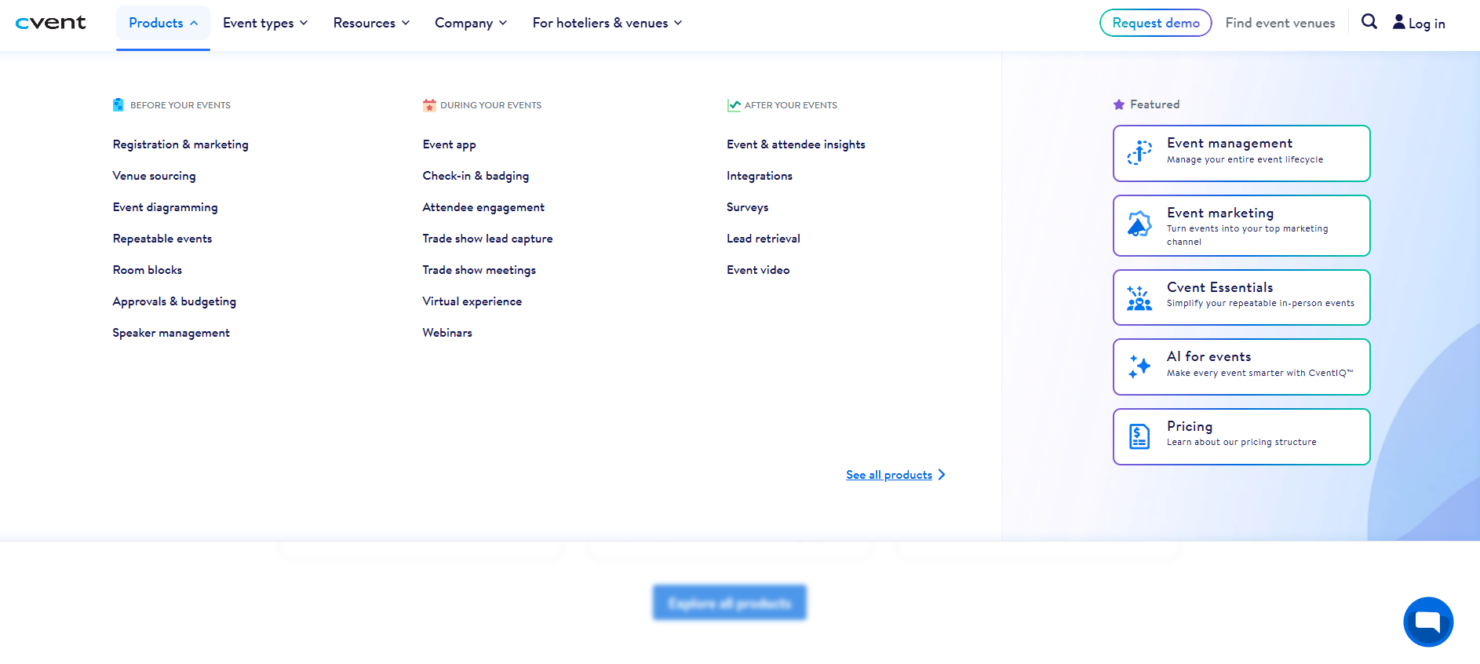
Cvent integrates with Salesforce, Marketo, HubSpot, Eloqua, Microsoft Dynamics 365, Concur, Zoom, Webex, On24, and Oracle Netsuite, among others.
Cvent also offers an API and connects with third-party integration tools for custom workflows and data syncing.
Cvent Specs
- Accounts Payable
- Accounts Receivable
- API
- Audience Targeting
- Budgeting
- Calendar Management
- Contact Management
- Customer Management
- Dashboard
- Data Export
- Data Import
- Data Visualization
- Expense Tracking
- External Integrations
- Forecasting
- General Account Ledger
- Inventory Tracking
- Lead Management
- Lead Scoring
- Marketing Automation
- Multi-User
- Notifications
- Project Management
- Scheduling
- Social-Media Integration
- Supplier Management
- Third-Party Plugins/Add-Ons
- Travel Management