
SeekerWorks-recension: Fördelar, nackdelar, funktioner & priser

We review tools independently, and commissions help fund our testing. See our transparency policy, our methodology, or suggest a tool.
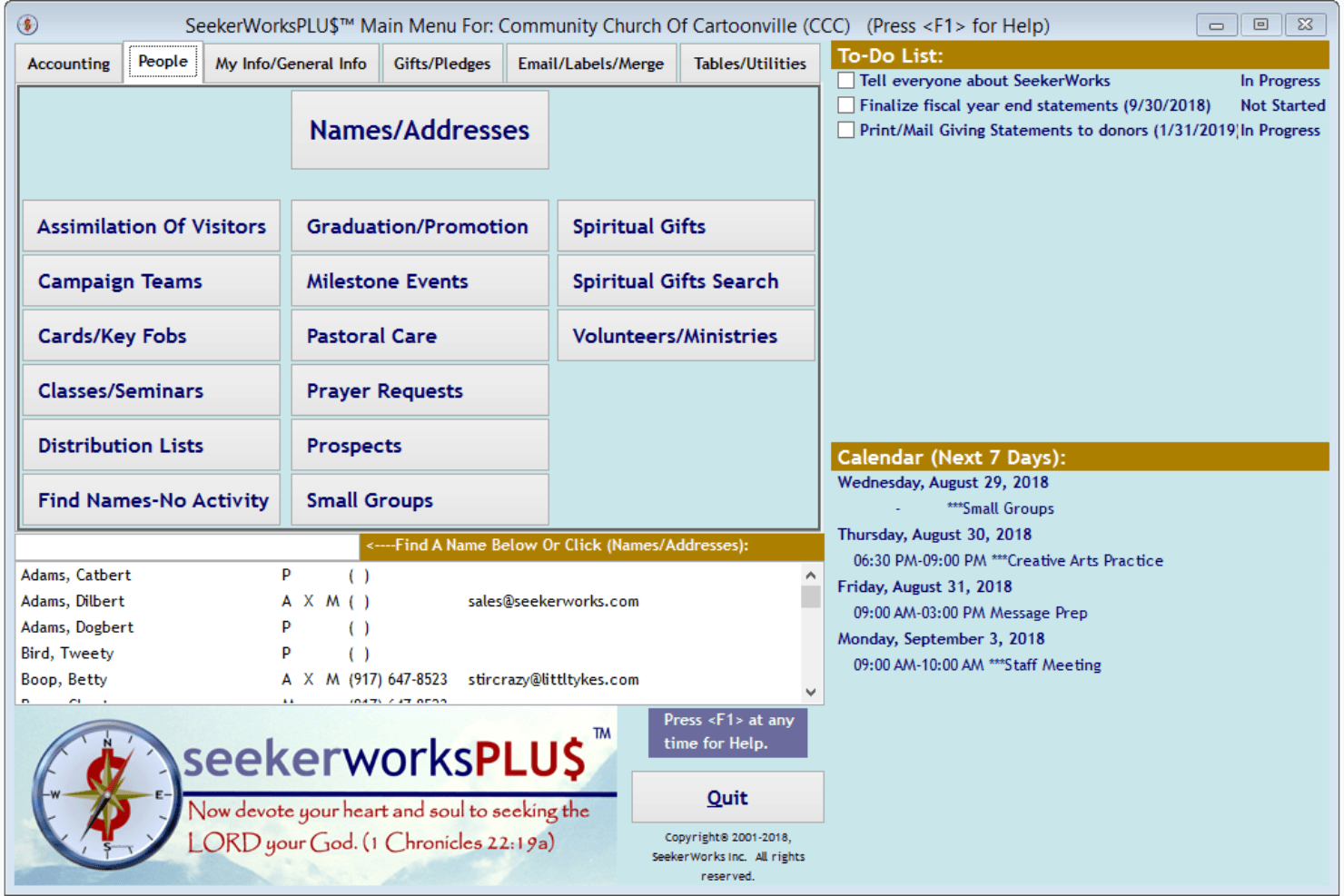
SeekerWorks is a church management software built to help churches manage their people, giving, and communications. I'd consider it seriously if you're leading a small-to-mid-sized congregation and find something like Planning Center's module-based structure more layered than you need—SeekerWorks takes a more focused approach that's easier to get up and running without a long onboarding curve.
SeekerWorks Evaluation Summary
4.7/5
- From $35/month
- 30-day free trial
Varför du kan lita på våra programvarurekommendationer
6,700+
Reviews
20
Industry experts
16+
Evaluation factors
14
Years
Vårt team har testat och granskat programvara sedan 2012. Som församlingsledare själva vet vi hur svårt — och viktigt — det är att välja rätt programvara.
För den här guiden utvärderade vi verktygen genom praktisk testning och oberoende research, och poängsatte verktygen utifrån våra urvalskriterier.
Våra recensioner speglar vårt mänskliga redaktionella omdöme, inte en säljpitch.
SeekerWorks Overview
In my opinion, SeekerWorks is a solid choice for churches seeking a management software that balances functionality and affordability. While it offers comprehensive tools that cater well to small and medium-sized churches, it could improve onboarding and customer support to compete with top-tier solutions.
It particularly shines in its ease of use and value for money, making it suitable for churches that need a straightforward yet effective management tool without a steep learning curve. If you're deciding between SeekerWorks and pricier options, consider your budget and the importance of personalized support.
Pros
- It has a user-friendly interface that simplifies church operations.
- You can efficiently manage member data and event scheduling.
- It offers great value for money, especially for small to mid-sized churches.
Cons
- Onboarding can be a bit challenging for new users.
- Customer support could be more responsive and personalized.
- It may lack some advanced features found in higher-priced solutions.
Is SeekerWorks Right For Your Needs?
Who Would be a Good Fit for SeekerWorks?
Small to mid-sized churches and non-profit religious organizations are ideal for SeekerWorks. If your team needs a straightforward tool to handle member data and event planning without a steep learning curve, this software is a great match. Its user-friendly interface allows your team to focus on community growth rather than technical hurdles.
- Small ChurchesSeekerWorks is perfect for small churches needing an easy-to-use platform for managing members and events.
- Non-ProfitsYour non-profit can benefit from SeekerWorks's efficient data management and communication tools.
- Volunteer TeamsIf you're coordinating volunteers, SeekerWorks simplifies scheduling and communication.
- Youth MinistriesYouth ministries can use SeekerWorks to organize activities and stay connected with members.
- Administrative StaffYour admin team will appreciate SeekerWorks's intuitive interface for managing daily tasks.
- Community GroupsCommunity groups can use SeekerWorks to keep track of members and plan events efficiently.
Who Would be a Bad Fit for SeekerWorks?
Large churches or organizations with complex administrative needs might find SeekerWorks lacking. If your team requires advanced features or highly personalized customer support, this software might not meet your expectations. It's not designed for those needing extensive customization or integration with other sophisticated tools.
- Large ChurchesSeekerWorks may struggle to handle the complex needs and large data volumes of big congregations.
- Tech-Savvy TeamsIf your team demands advanced features and customization, SeekerWorks might feel too basic.
- Corporate ChurchesCorporate-style churches needing extensive reporting and analytics might find SeekerWorks insufficient.
- Multi-Site ChurchesManaging multiple locations could prove challenging due to SeekerWorks's limited scalability.
- High-Volume Data UsersIf you handle large amounts of data, SeekerWorks's capabilities might not be robust enough.
- Advanced Event PlannersFor those planning large-scale events, SeekerWorks might lack the detailed features required.
How We Test & Score Tools
We’ve spent years building, refining, and improving our software testing and scoring system. The rubric is designed to capture the nuances of software selection and what makes a tool effective, focusing on critical aspects of the decision-making process.
Below, you can see exactly how our testing and scoring works across seven criteria. It allows us to provide an unbiased evaluation of the software based on core functionality, standout features, ease of use, onboarding, customer support, integrations, customer reviews, and value for money.
Core Functionality (25% of final scoring)
The starting point of our evaluation is always the core functionality of the tool. Does it have the basic features and functions that a user would expect to see? Are any of those core features locked to higher-tiered pricing plans? At its core, we expect a tool to stand up against the baseline capabilities of its competitors.
Standout Features (25% of final scoring)
Next, we evaluate uncommon standout features that go above and beyond the core functionality typically found in tools of its kind. A high score reflects specialized or unique features that make the product faster, more efficient, or offer additional value to the user.
We also evaluate how easy it is to integrate with other tools typically found in the tech stack to expand the functionality and utility of the software. Tools offering plentiful native integrations, 3rd party connections, and API access to build custom integrations score best.
Ease of Use (10% of final scoring)
We consider how quick and easy it is to execute the tasks defined in the core functionality using the tool. High scoring software is well designed, intuitive to use, offers mobile apps, provides templates, and makes relatively complex tasks seem simple.
Onboarding (10% of final scoring)
We know how important rapid team adoption is for a new platform, so we evaluate how easy it is to learn and use a tool with minimal training. We evaluate how quickly a team member can get set up and start using the tool with no experience. High scoring solutions indicate little or no support is required.
Customer Support (10% of final scoring)
We review how quick and easy it is to get unstuck and find help by phone, live chat, or knowledge base. Tools and companies that provide real-time support score best, while chatbots score worst.
Customer Reviews (10% of final scoring)
Beyond our own testing and evaluation, we consider the net promoter score from current and past customers. We review their likelihood, given the option, to choose the tool again for the core functionality. A high scoring software reflects a high net promoter score from current or past customers.
Value for Money (10% of final scoring)
Lastly, in consideration of all the other criteria, we review the average price of entry level plans against the core features and consider the value of the other evaluation criteria. Software that delivers more, for less, will score higher.
SeekerWorks Specs
- API: No
- Calendar Management: No
- Contact Management: No
- Dashboards: No
- Data Export: No
- Data Import: No
- Document Management: No
- External Integrations: No
- Multi-User: No
- Notifications: No
- Payment Gateway Integration: No
- Scheduling: No
- Workflow Management: No
Alternatives to SeekerWorks


SeekerWorks FAQs
Vad händer härnäst?
Prenumerera på vårt nyhetsbrev för att få de senaste resurserna, bästa praxis och insikter om att leda kyrkor från erfarna pastorer och kyrkoledare.