

ChMeetings-arvostelu: hyvät ja huonot puolet, ominaisuudet ja hinnoittelu vuodelle 2026
ChMeetings is an all-in-one church management software for managing members, giving, events, volunteers, communications, and other day-to-day church operations. Find out whether ChMeetings is the right fit for your church in my expert review.

We review tools independently, and commissions help fund our testing. See our transparency policy, our methodology, or suggest a tool.
Church administration can become difficult to manage when member records, giving, events, volunteer schedules, and communications are spread across different tools. As ministries grow, keeping those moving parts organized without adding more manual work becomes increasingly important.
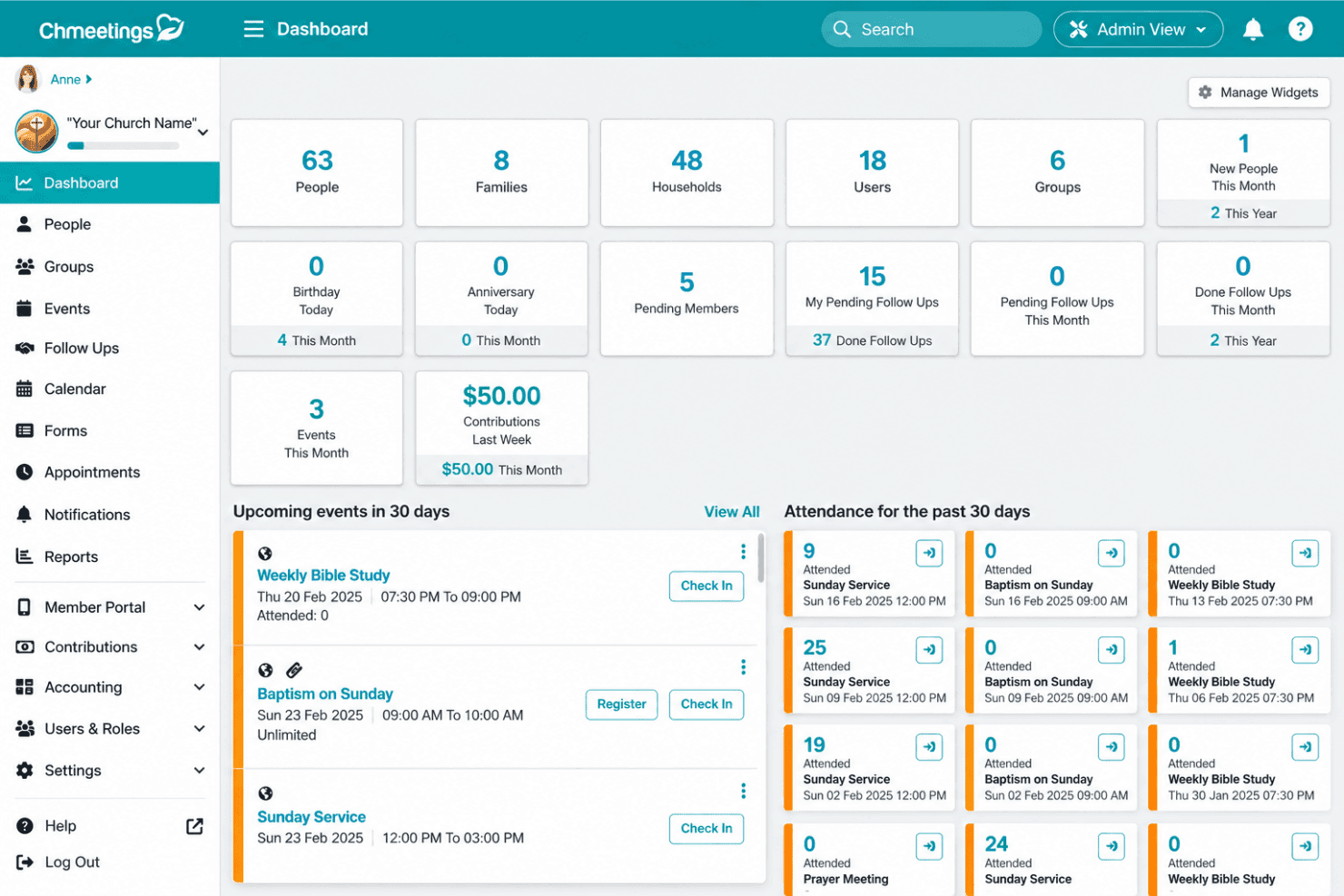
ChMeetings is an all-in-one church management software designed to help churches manage members, giving, events, volunteers, worship planning, communications, and other day-to-day operations from a central system. It also offers church accounting, member-facing tools, automation, and AI features for organizations ranging from small congregations to multi-campus churches and dioceses.
In this review, I’ll help you assess whether ChMeetings is the right fit for your church.
ChMeetings Evaluation Summary
4.9/5
- From $12/month
- Free plan available + 30-day free trial
Miksi luottaa ohjelmistosuosituksiimme
6,700+
Reviews
20
Industry experts
16+
Evaluation factors
14
Years
Tiimimme on testannut ja arvioinut ohjelmistoja vuodesta 2012 lähtien. Seurakuntajohtajina tiedämme itse, kuinka vaikeaa — ja tärkeää — oikean ohjelmiston valitseminen on.
Tätä opasta varten arvioimme työkaluja käytännön testauksen ja itsenäisen tutkimuksen avulla, pisteyttäen työkalut valintakriteeriemme perusteella.
Arvostelumme perustuvat inhimilliseen toimitukselliseen harkintaamme, eivät myyntipuheeseen.
ChMeetings Overview
In my opinion, ChMeetings stands out for the breadth of church administration it brings into one system, covering member management, giving, events, volunteer scheduling, worship planning, communications, and fund accounting. Its member portal, mobile app, AI-assisted tools, and support for multi-church and diocesan structures add useful depth beyond basic membership tracking. The main trade-offs are US-only data residency, some important features being limited to higher plans, and extra costs for certain add-ons and messaging services.
Pros
- Combines member management, giving, events, volunteers, worship planning, communications, and fund accounting in one church-focused system.
- Member portal and mobile app let congregants update profiles, register for events, give online, and receive church communications directly.
- Built-in AI supports tasks such as people searches, form creation, and email drafting, while read-only AI connections can query church data without changing records.
Cons
- Customer data is hosted only in the United States, with no option to choose another hosting region.
- Some capabilities, including accounting and appointments, require higher paid plans.
- SMS and voice messaging require additional credits, adding usage-based costs beyond the subscription price.
Is ChMeetings Right For Your Needs?
Who Would be a Good Fit for ChMeetings?
ChMeetings is a good fit for churches and faith-based organizations that want to manage people, giving, events, volunteers, communications, worship planning, and finances in the same system. It can support everything from small congregations to multi-campus churches and dioceses, with features that become more useful as administrative needs grow.
- Small and Growing ChurchesSmaller churches can start with core member, giving, event, and communication tools, then expand into more advanced features as their needs grow.
- Mid-Sized and Large ChurchesLarger congregations can manage membership, attendance, giving, volunteers, worship planning, accounting, forms, and follow-ups without splitting those workflows across several systems.
- Multi-Campus ChurchesMulti-location churches can organize people, ministries, groups, events, and permissions across locations while maintaining centralized administration.
- Dioceses and Church NetworksDioceses can oversee multiple independent churches, manage shared members and reporting, and run elections while allowing each church to manage its own operations.
- Churches Consolidating Multiple ToolsChurches using separate systems for membership, giving, worship planning, communications, and accounting can bring more of those workflows into ChMeetings.
- Faith-Based Nonprofits and MinistriesChristian nonprofits and ministries with similar needs around membership, donations, events, groups, and fund accounting may also be a good fit.
Who Would be a Bad Fit for ChMeetings?
ChMeetings is less suitable when an organization’s main requirements fall outside church or faith-based administration. It can also be a poor fit when data residency, specialist integrations, or free-only usage are non-negotiable.
- General BusinessesBusinesses focused on sales pipelines, inventory, retail operations, or other commercial workflows will usually be better served by purpose-built business software.
- Organizations Requiring Regional Data HostingOrganizations that require customer data to be hosted outside the United States are not a good fit because ChMeetings does not currently offer regional hosting options.
- Free-Only Organizations With Larger DatabasesChurches that need to stay entirely on a free plan but exceed its people or feature limits will need another option.
- Organizations With Mandatory Specialist IntegrationsOrganizations that depend on a specific specialist system should verify compatibility first, as unsupported integrations could rule ChMeetings out.
- Organizations Outside Faith-Based or Membership WorkflowsOrganizations whose operations do not center on members, donations, groups, events, or fund accounting may get more value from software built for their sector.
How We Test & Score Tools
We’ve spent years building, refining, and improving our software testing and scoring system. The rubric is designed to capture the nuances of software selection and what makes a tool effective, focusing on critical aspects of the decision-making process.
Below, you can see exactly how our testing and scoring works across seven criteria. It allows us to provide an unbiased evaluation of the software based on core functionality, standout features, ease of use, onboarding, customer support, integrations, customer reviews, and value for money.
Core Functionality (25% of final scoring)
The starting point of our evaluation is always the core functionality of the tool. Does it have the basic features and functions that a user would expect to see? Are any of those core features locked to higher-tiered pricing plans? At its core, we expect a tool to stand up against the baseline capabilities of its competitors.
Standout Features (25% of final scoring)
Next, we evaluate uncommon standout features that go above and beyond the core functionality typically found in tools of its kind. A high score reflects specialized or unique features that make the product faster, more efficient, or offer additional value to the user.
We also evaluate how easy it is to integrate with other tools typically found in the tech stack to expand the functionality and utility of the software. Tools offering plentiful native integrations, 3rd party connections, and API access to build custom integrations score best.
Ease of Use (10% of final scoring)
We consider how quick and easy it is to execute the tasks defined in the core functionality using the tool. High scoring software is well designed, intuitive to use, offers mobile apps, provides templates, and makes relatively complex tasks seem simple.
Onboarding (10% of final scoring)
We know how important rapid team adoption is for a new platform, so we evaluate how easy it is to learn and use a tool with minimal training. We evaluate how quickly a team member can get set up and start using the tool with no experience. High scoring solutions indicate little or no support is required.
Customer Support (10% of final scoring)
We review how quick and easy it is to get unstuck and find help by phone, live chat, or knowledge base. Tools and companies that provide real-time support score best, while chatbots score worst.
Customer Reviews (10% of final scoring)
Beyond our own testing and evaluation, we consider the net promoter score from current and past customers. We review their likelihood, given the option, to choose the tool again for the core functionality. A high scoring software reflects a high net promoter score from current or past customers.
Value for Money (10% of final scoring)
Lastly, in consideration of all the other criteria, we review the average price of entry level plans against the core features and consider the value of the other evaluation criteria. Software that delivers more, for less, will score higher.
Core Features
People and Group Management
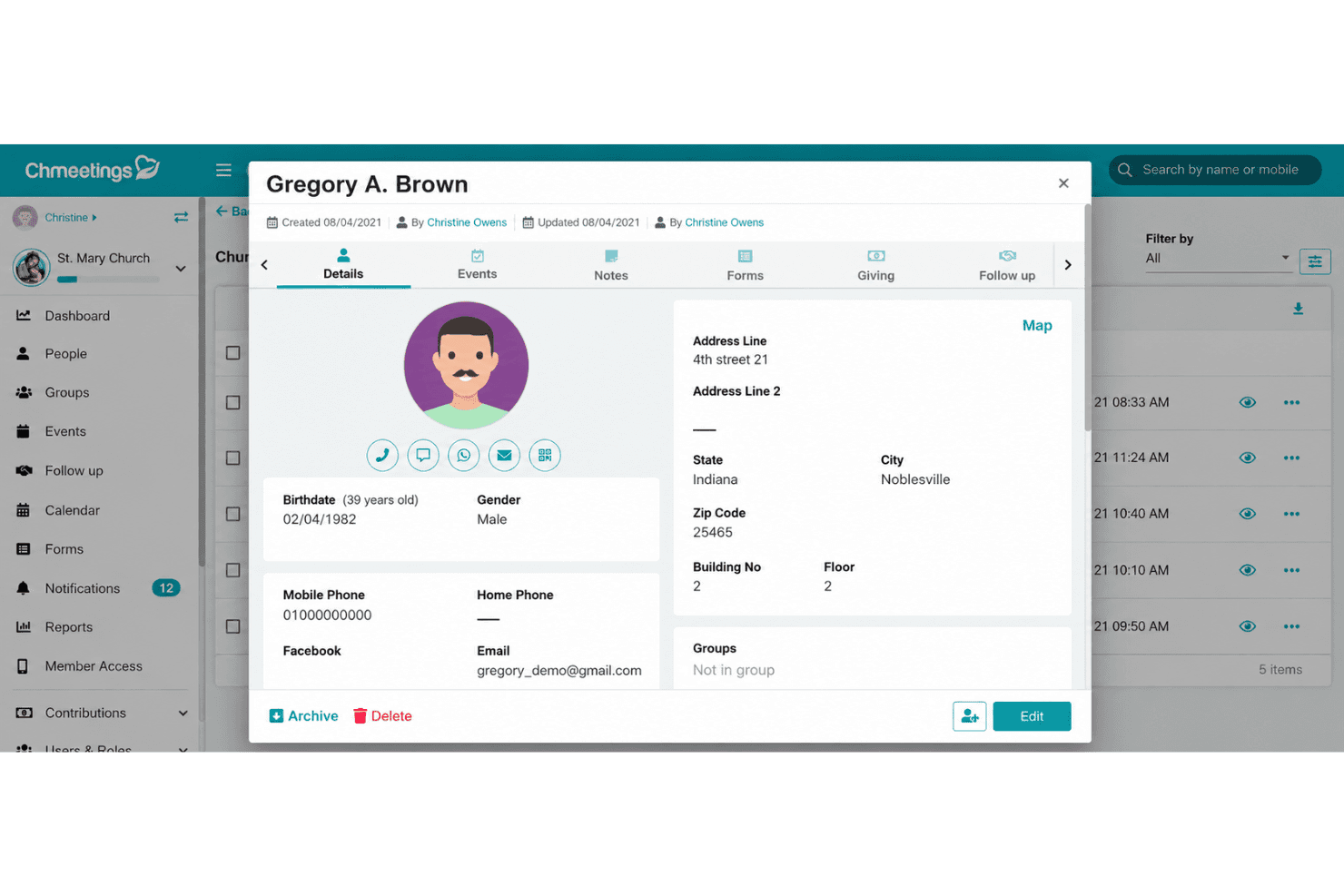
Maintain member and household profiles, ministry involvement, custom fields, and group assignments in a central directory. Leaders can update records in bulk, merge duplicates, create filtered groups, and assign access based on staff or volunteer roles.
Giving and Church Accounting
Track online and offline contributions, pledges, funds, budgets, bank transactions, and financial reports within the same system. Connecting giving records with fund accounting helps churches keep donor activity and financial records more closely aligned.
Events, Check-In and Volunteer Scheduling
Create free or paid events, manage registrations, schedule volunteers, and track attendance from desktop or mobile devices. ChMeetings also supports QR-code check-in and child check-in with family tracking and name-tag printing.
Worship Planning
Build service plans with songs, prayers, sermons, announcements, and other service elements in order. Teams can maintain a song library, assign worship and technical roles, and coordinate responsibilities for upcoming services.
Communications, Forms and Follow-Ups
Send email, SMS, voice messages, and push notifications to members or groups, while follow-up tools help teams manage outreach to visitors and congregants. Custom forms can collect information, update member profiles, accept payments, and track responses.
Member Portal and Mobile App
Members can use ChMeetings on web and mobile to update profiles, access groups, register for events, give online, and receive church communications. Churches can also add the optional Custom Branded Church App with their own name, logo, colors, and member-facing features such as group chat, prayer requests, sermon media, volunteering, events, giving, and push notifications.
Standout Features
AI-Assisted Church Administration
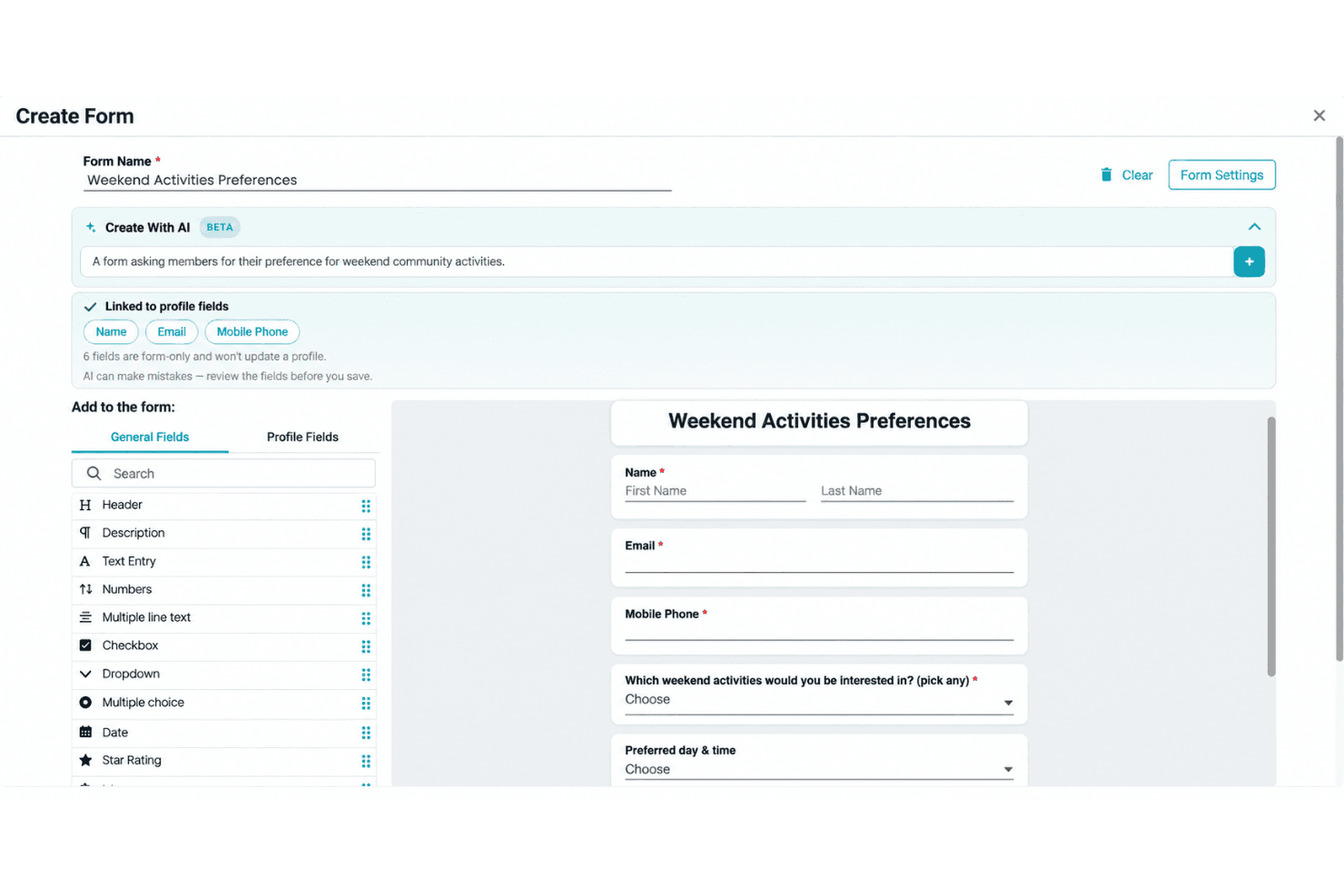
ChMeetings uses AI for everyday administrative tasks, including turning natural-language people searches into reviewable filters, creating forms, and drafting emails. Churches can also connect compatible external AI tools to their data through a read-only connection, allowing teams to ask questions about church records without giving the AI permission to modify them.
Diocese and Multi-Church Management
ChMeetings supports dioceses and larger organizations that need centralized oversight across multiple independent churches. Each church can manage its own operations while the parent organization oversees reporting and administration, with support for shared members and diocesan elections from nominations through voting and results.
Ease of Use
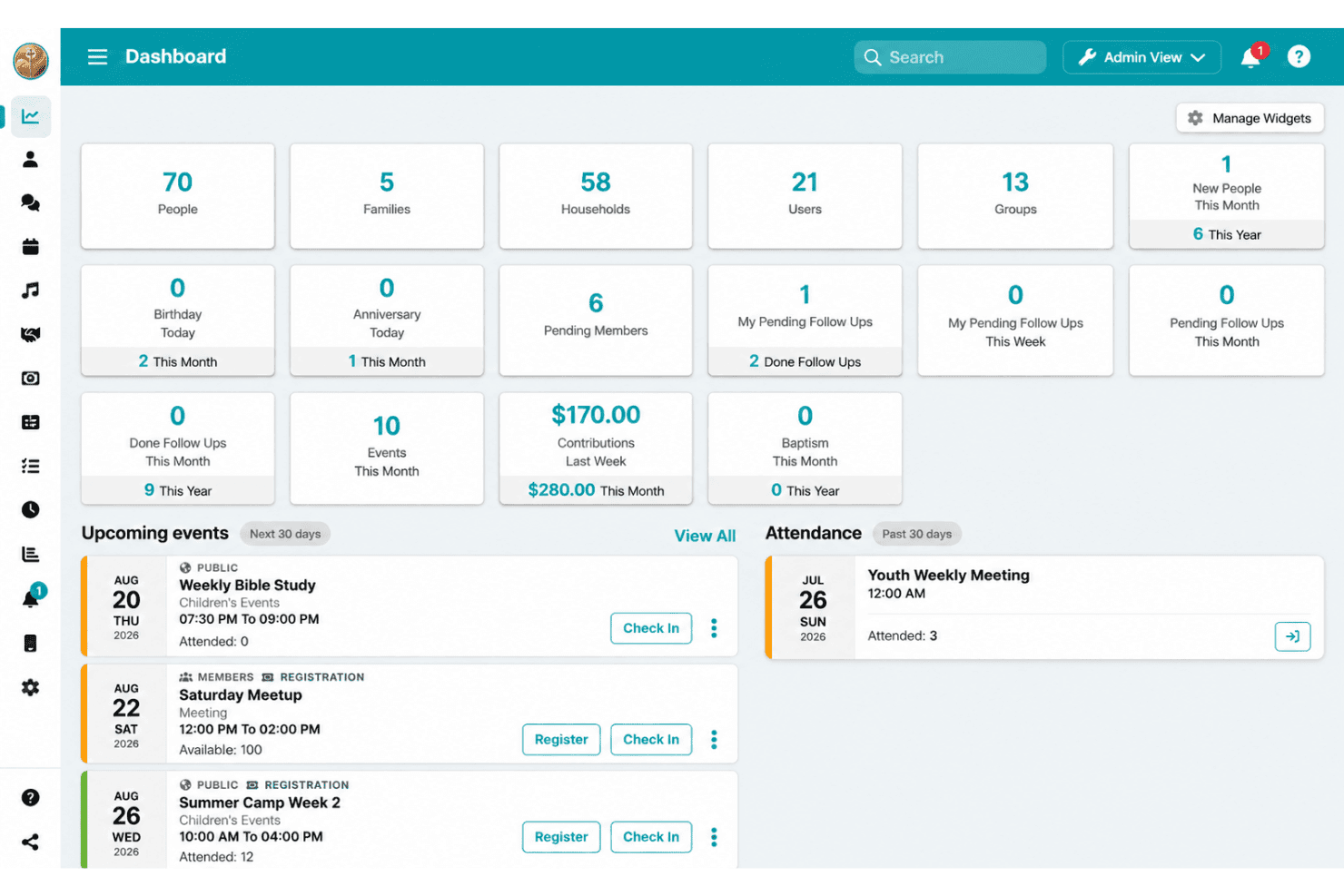
ChMeetings packs a lot into the interface, so I wouldn’t call it minimalist. You’re moving between member records, groups, giving, events, worship planning, accounting, and follow-ups, which naturally takes some getting used to. The upside is that most day-to-day tasks stay inside the same system, so churches willing to spend a little time learning the layout can avoid juggling several separate tools.
Onboarding
Getting started can be self-serve, but ChMeetings also offers a free guided onboarding session if you want someone to walk you through setup. The bigger advantage is migration: every paid plan includes free data transfer, including accounting records, handled by a dedicated migration team. They import and validate the data before the church reviews it, and most migrations take around 3–10 business days depending on the size and complexity of the source data.
Customer Support
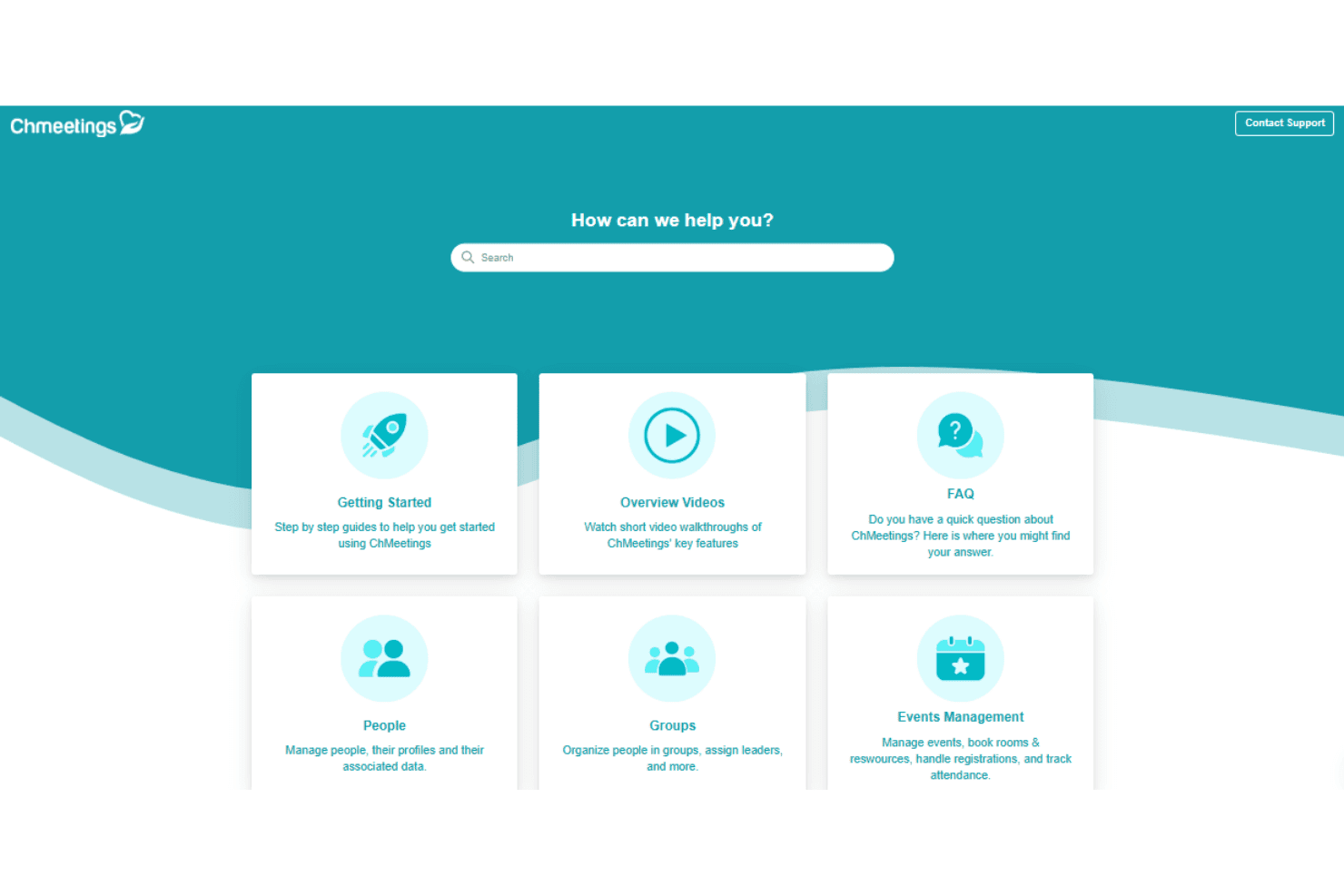
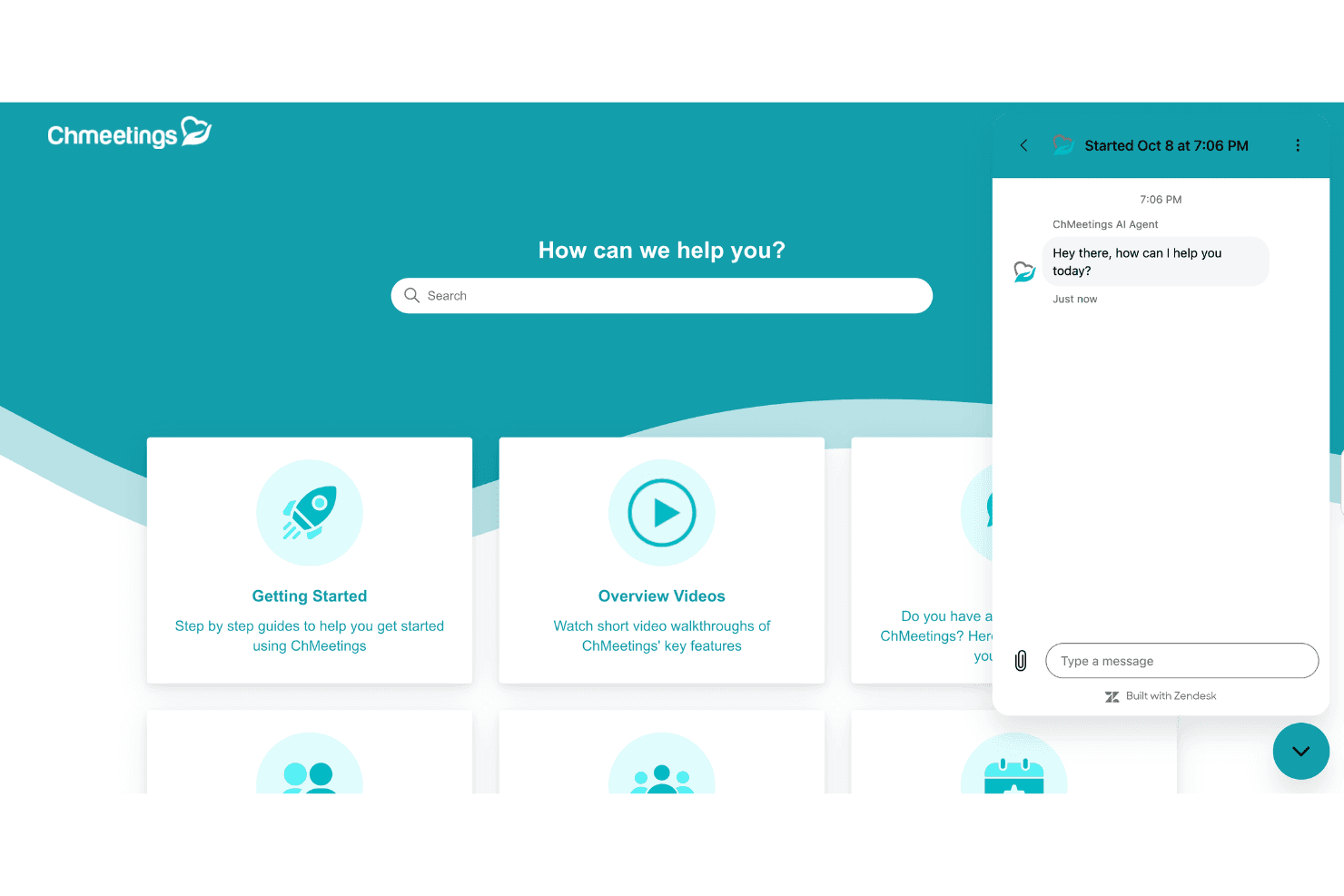
Support is one of the areas where ChMeetings feels more hands-on. Church admins can use phone, live chat, Zoom, help articles, and video walkthroughs rather than relying on documentation alone. That matters with a system this broad, especially when the person managing it may be a pastor, volunteer, or church administrator rather than someone with a technical background.
Integrations
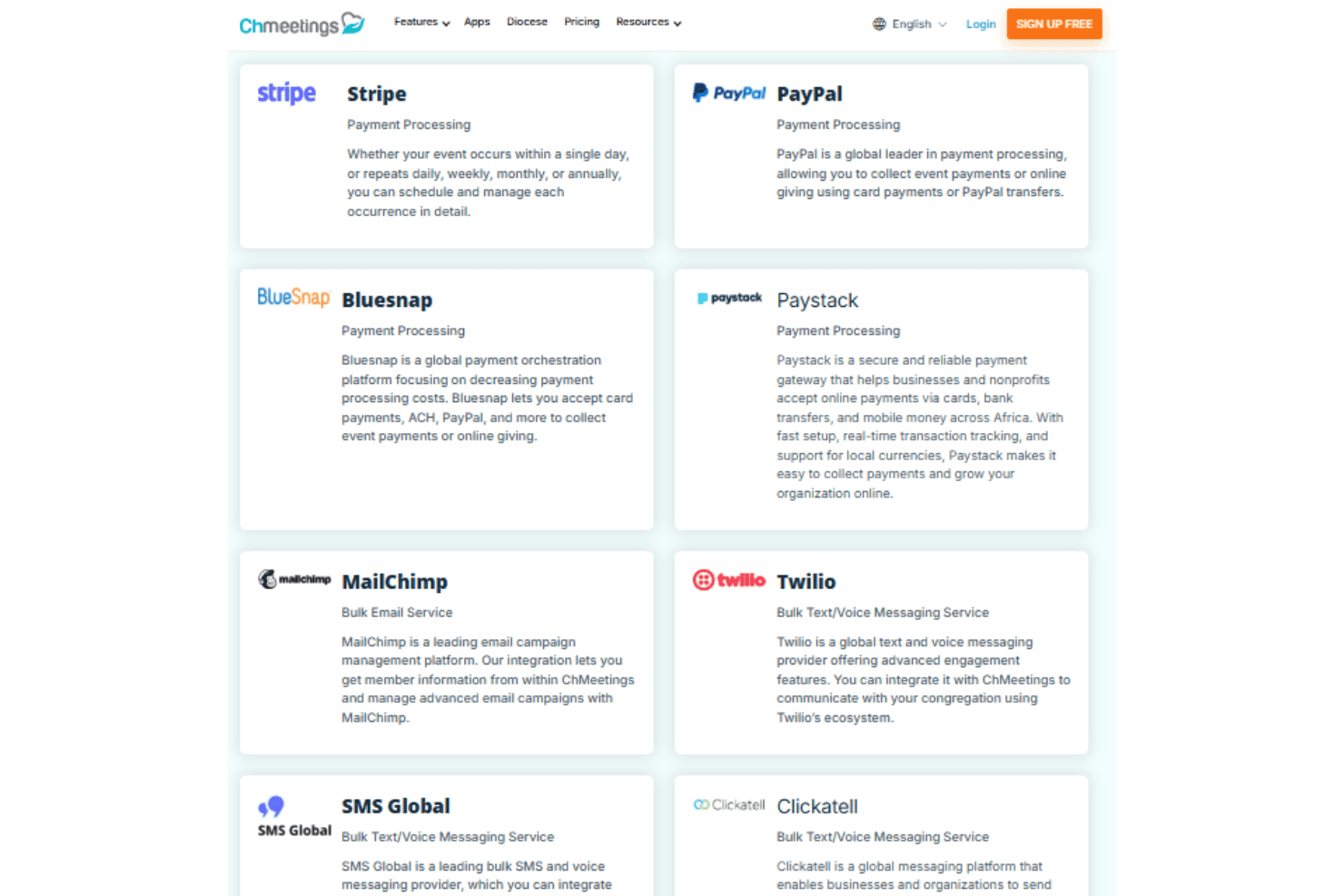
ChMeetings integrates with Stripe, PayPal, Paystack, MailChimp, Twilio, SMSGlobal, Clickatell, EazismsPro, Bulk SMS Nigeria, and Telstra Whispir, among others.
It also supports a developer API and webhooks for custom integrations, while Zapier can connect ChMeetings with third-party tools such as Zeffy.
Value for Money
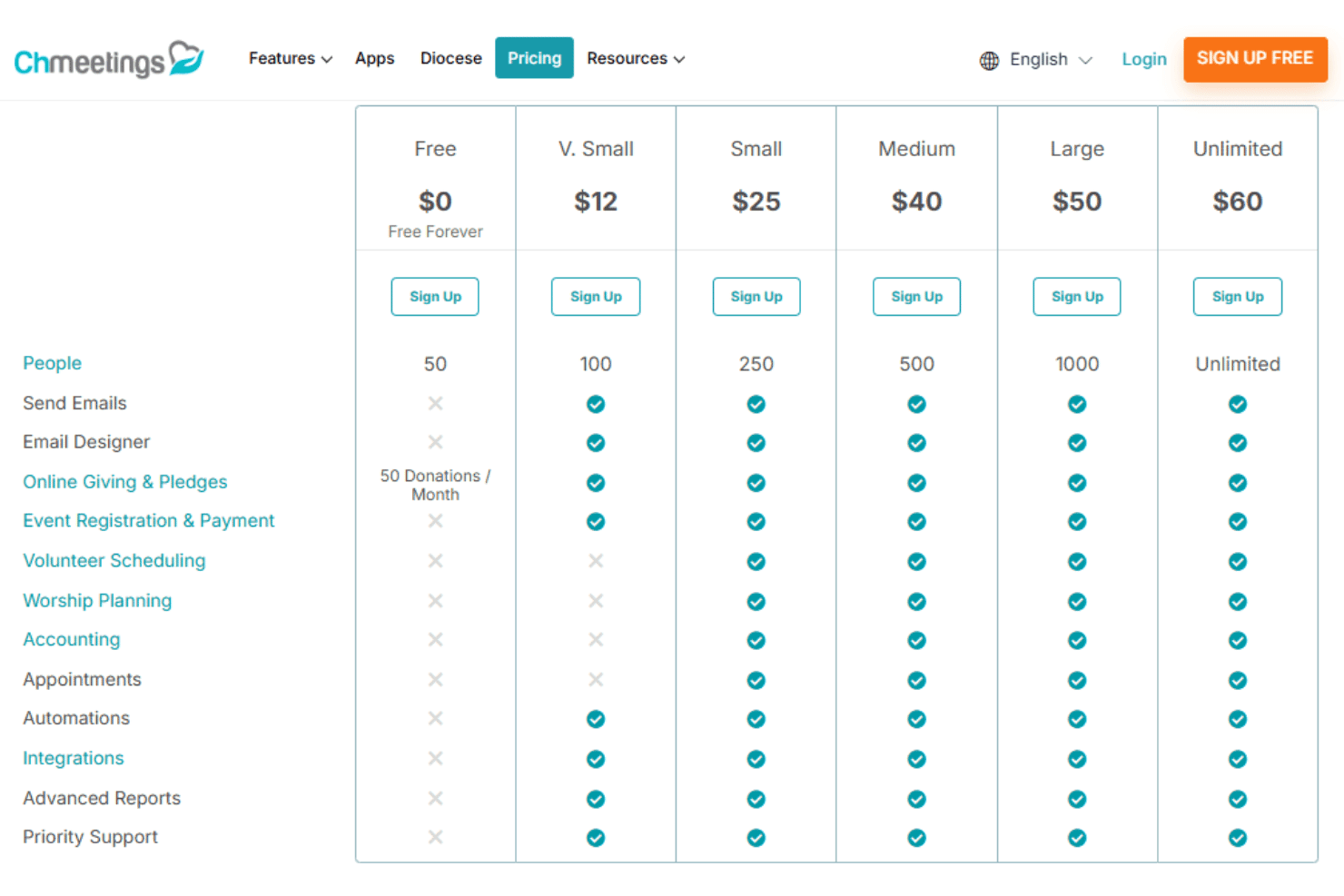
ChMeetings offers a broad set of church management tools for the cost, with pricing based on active people rather than admin seats. Archived and deleted records do not count toward plan limits, and there is no cap on administrators, so churches do not have to pay more simply to give additional staff or volunteers access. ChMeetings also does not charge its own transaction fee on donations, although payment processor fees still apply. Paid plans include free data migration, while the custom branded app and certain third-party services come at an additional cost.
- Free: Includes people and group management, contribution tracking and pledges, basic event registration and check-in, forms, follow-ups, the member portal, mobile app access, and general reporting. Online giving is limited to 50 donations per month, and features such as email, automation, accounting, and volunteer scheduling are excluded.
- V. Small: Adds email, paid and guest event registration, automated tasks, expanded member portal and form capabilities, free data migration, and priority support. It does not include accounting, appointments, volunteer scheduling, or worship planning.
- Small: Adds volunteer scheduling, worship planning, appointments, and church accounting, making this the first tier with ChMeetings’ broader operational and financial toolset.
- Medium: Includes the same major feature set as Small while increasing the number of active people the church can manage.
- Large: Retains the same major feature set with a higher active-person allowance for larger congregations.
- Unlimited: Removes the active-person limit and adds elections management, including nominations, candidate confirmation, voting, and results.
ChMeetings Specs
- API: Yes
- Calendar Management: Yes
- Contact Management: Yes
- Dashboards: Yes
- Data Export: Yes
- Data Import: Yes
- Document Management: No
- External Integrations: Yes
- Multi-User: Yes
- Notifications: Yes
- Payment Gateway Integration: Yes
- Scheduling: Yes
- Workflow Management: Yes
ChMeetings FAQs
ChMeetings Company Overview & History
ChMeetings is a church management platform launched in 2018 by Jios Apps Inc., a U.S.-based software company with its head office in Wellington, Florida. The product grew out of the team’s own church involvement, with its founder and most developers serving in Youth Ministry, Couples’ Ministry, or Sunday School. Today, ChMeetings serves more than 8,000 churches, ministries, and dioceses worldwide.
ChMeetings Major Milestones
- 2018: Launched as a church management platform.
- 2026: Serves more than 8,000 churches, ministries, and dioceses worldwide.